

Want educational insights in your inbox? Sign up for our weekly newsletters to get only what matters to your organization. Subscribe Now
Introduction
As artificial intelligence continues to transform industries, organizations are now facing a critical challenge — how to govern AI responsibly. With models influencing decisions across finance, healthcare, HR, and security, ensuring fairness, transparency, and compliance is no longer optional.
AI Model Governance has emerged as the cornerstone of responsible AI adoption. It encompasses the systems, frameworks, and controls needed to ensure that AI models are ethical, compliant, and explainable throughout their lifecycle.
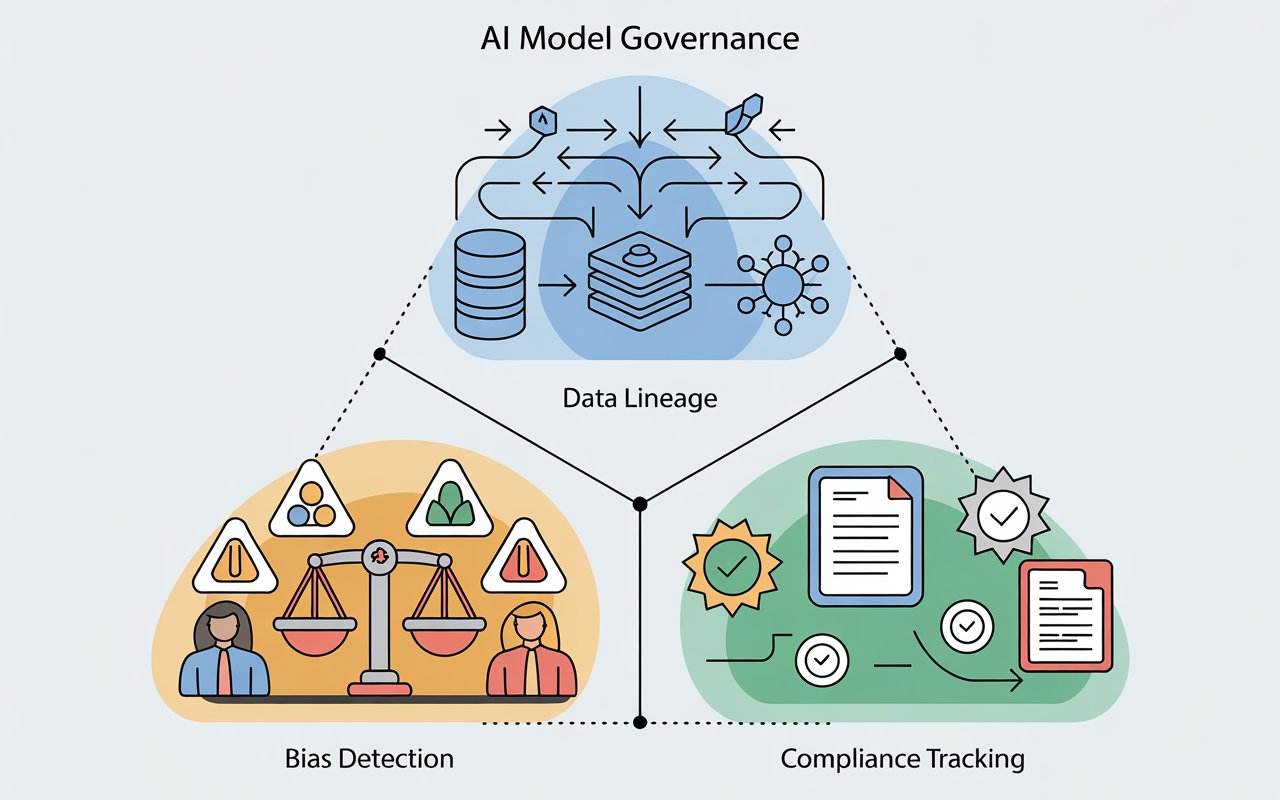
In this educational blog, we explore the key components of AI model governance — data lineage, bias detection, and compliance tracking — and how organizations can use AI-powered tools to automate and scale these functions effectively.
Understanding AI Model Governance
AI model governance refers to the policies, processes, and technologies that ensure AI models are developed, deployed, and maintained responsibly.
It covers the entire AI lifecycle, from data collection and model training to deployment and post-launch monitoring.
Effective governance helps organizations:
-
Reduce regulatory and reputational risks
-
Improve model transparency and explainability
-
Detect and mitigate bias
-
Strengthen accountability through audit trails
1. Data Lineage: Tracing AI’s Digital DNA
Data lineage is the foundation of AI governance. It tracks where data comes from, how it’s transformed, and where it’s used within the model pipeline.
By maintaining a complete record of datasets and their transformations, organizations can:
✅ Ensure regulatory compliance (GDPR, CCPA, ISO 42001)
✅ Identify and correct data quality issues early
✅ Provide auditors with transparent data trails
✅ Build trust by proving the integrity of model outcomes
Modern AI governance platforms use automated lineage mapping powered by AI to visualize data flow from ingestion to inference. This not only reduces human error but also improves traceability across multiple AI environments.
2. Bias Detection: Ensuring Fairness and Ethical AI
Bias in AI systems can lead to discriminatory outcomes and damage public trust. AI bias detection tools help identify and measure unfair patterns within models.
Common types of bias include:
-
Data Bias: When training data underrepresents certain groups.
-
Algorithmic Bias: When model logic amplifies inequalities.
-
Evaluation Bias: When testing metrics fail to reflect diverse use cases.
AI-powered bias detection platforms use statistical fairness metrics such as:
-
Demographic Parity
-
Equalized Odds
-
Disparate Impact Ratio
Through continuous monitoring, organizations can detect when model performance begins to deviate or favor certain demographics, allowing for timely corrections.
3. Compliance Tracking: Staying Ahead of AI Regulations
With the rise of global AI regulations like the EU AI Act, NIST AI RMF, and OECD AI Principles, organizations must prove that their AI systems are compliant, explainable, and auditable.
AI compliance tracking automates this process by:
-
Mapping models to compliance standards
-
Generating explainability and risk reports
-
Maintaining immutable audit logs
-
Alerting teams to regulatory changes
AI-driven compliance platforms also integrate with model management systems to provide real-time dashboards for legal, risk, and compliance teams — ensuring continuous oversight without slowing innovation.
4. Automating AI Governance with Machine Learning
AI governance itself is evolving through automation. Organizations now leverage AI to monitor AI — using machine learning algorithms to detect anomalies, track drift, and flag non-compliance in real time.
Key features of AI-powered governance systems include:
-
Automated bias scoring and alerts
-
Smart compliance dashboards
-
Lifecycle version control
-
Explainability visualizations for auditors
This “AI-governing-AI” approach enables scalable governance across hundreds of models while reducing human workload and error.
5. Building a Governance-First AI Culture
Technology alone isn’t enough — governance must be part of the organizational culture.
Establishing a cross-functional AI ethics committee, providing continuous staff training, and embedding governance principles into data pipelines can help create a privacy-first and fairness-first AI environment.
When governance becomes an organizational norm, AI transitions from being a risk to becoming a trusted asset.
Conclusion
AI model governance isn’t just a compliance requirement — it’s a strategic advantage.
By integrating data lineage, bias detection, and compliance tracking into the AI lifecycle, organizations can build models that are not only powerful but also transparent, ethical, and trustworthy.
As AI adoption accelerates, those who invest in responsible governance frameworks today will lead tomorrow’s intelligent enterprises — with confidence, compliance, and credibility.
References
-
NIST (2024). AI Risk Management Framework (RMF).
-
IBM Research (2025). Trustworthy AI Lifecycle Management.
-
EU Commission (2024). Artificial Intelligence Act Overview.
-
McKinsey & Co. (2025). Building Responsible AI at Scale.
-
Gartner (2025). Governance Strategies for Enterprise AI Systems.
#AIGovernance #ModelGovernance #AICompliance #ResponsibleAI #AIEthics