

Want educational insights in your inbox? Sign up for our weekly newsletters to get only what matters to your organization. Subscribe Now
Introduction: The Year Cybersecurity Lines Blurred
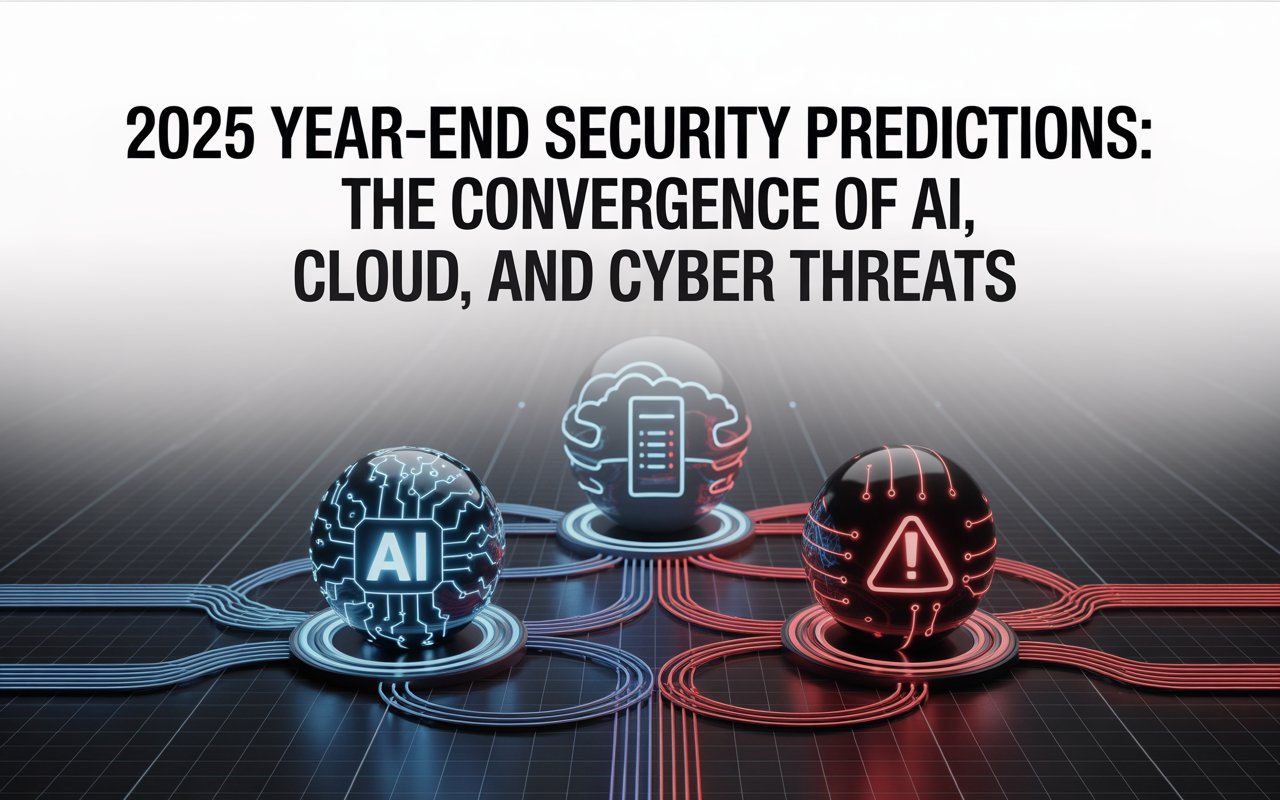
As 2025 draws to a close, one theme dominates the global cybersecurity landscape — convergence.
AI, cloud computing, and connected systems have become inseparable. While this integration drives innovation and efficiency, it also introduces an unprecedented level of interdependence — and vulnerability.
From large-scale AI model breaches to complex multi-cloud ransomware attacks, the year has demonstrated that digital ecosystems can no longer be secured in isolation. In this year-end analysis, The Security Bench explores the top predictions shaping cybersecurity in Q4 2025 and into 2026, along with actionable steps for organizations to prepare.
1️⃣ AI Will Become Both the Shield and the Sword
In 2025, AI-driven cybersecurity tools reached new levels of automation — enabling real-time threat detection, predictive modeling, and incident response. However, attackers are now equally leveraging AI for reconnaissance, social engineering, and code obfuscation.
🔹 Prediction:
By mid-2026, over 60% of cyberattacks will include an AI-generated component — from deepfake phishing to AI-assisted malware generation.
🔹 Preparation Strategy:
Organizations must implement AI governance frameworks, regularly test their models for adversarial manipulation, and invest in explainable AI (XAI) for transparency in automated decision-making.
2️⃣ Cloud Fragmentation Will Redefine Security Operations
The shift toward hybrid and multi-cloud infrastructures has given rise to security blind spots between platforms. In 2025, misconfigurations and identity mismanagement remained among the top causes of data breaches.
🔹 Prediction:
Cloud providers will introduce cross-cloud Zero Trust orchestration tools by 2026, enabling unified security visibility and automated compliance across providers.
🔹 Preparation Strategy:
Enterprises should adopt Cloud Security Posture Management (CSPM) integrated with AI-driven anomaly detection to continuously monitor configuration drift and policy violations.
3️⃣ The Era of AI-Driven Data Compliance
With new privacy regulations emerging worldwide, manual compliance management is becoming obsolete. Regulators now expect organizations to demonstrate data lineage, consent tracking, and bias mitigation — all powered by intelligent automation.
🔹 Prediction:
AI-driven RegTech platforms will dominate the compliance landscape, using machine learning to detect privacy violations before they escalate into breaches.
🔹 Preparation Strategy:
Implement automated compliance dashboards that track regulatory updates in real time and link directly to data repositories across cloud and edge environments.
4️⃣ IoT and Edge Devices Will Be the Next Cyber Frontline
As smart cities and healthcare IoT networks expand, attackers are shifting toward edge-based exploits — compromising devices at the periphery to infiltrate enterprise networks.
🔹 Prediction:
By late 2026, IoT-driven attacks will account for 40% of reported enterprise security incidents.
🔹 Preparation Strategy:
Use AI-enhanced behavioral monitoring to identify abnormal IoT activity, and enforce device identity management systems that authenticate every endpoint before granting access.
5️⃣ Human Factors Will Remain the Weakest Link — but the Strongest Defense
Even with advanced technology, human behavior continues to dictate security success. Phishing, credential reuse, and social engineering remain top breach vectors — but awareness training powered by gamified AI simulations is improving outcomes.
🔹 Prediction:
By 2026, organizations that invest in continuous awareness training will see a 70% reduction in successful phishing attacks.
🔹 Preparation Strategy:
Adopt adaptive learning platforms that personalize training content based on employee behavior and real-time threat data.
Conclusion: Preparing for a Hyperconnected 2026
The convergence of AI, cloud, and IoT has redefined what it means to secure an enterprise. In 2025, cybersecurity is no longer about building walls — it’s about building awareness, adaptability, and accountability.
As we move into 2026, successful organizations will be those that combine Zero Trust principles, AI-driven monitoring, and cross-domain visibility to outpace adversaries.
The future isn’t just digital — it’s intelligent, and it demands intelligent defense.