

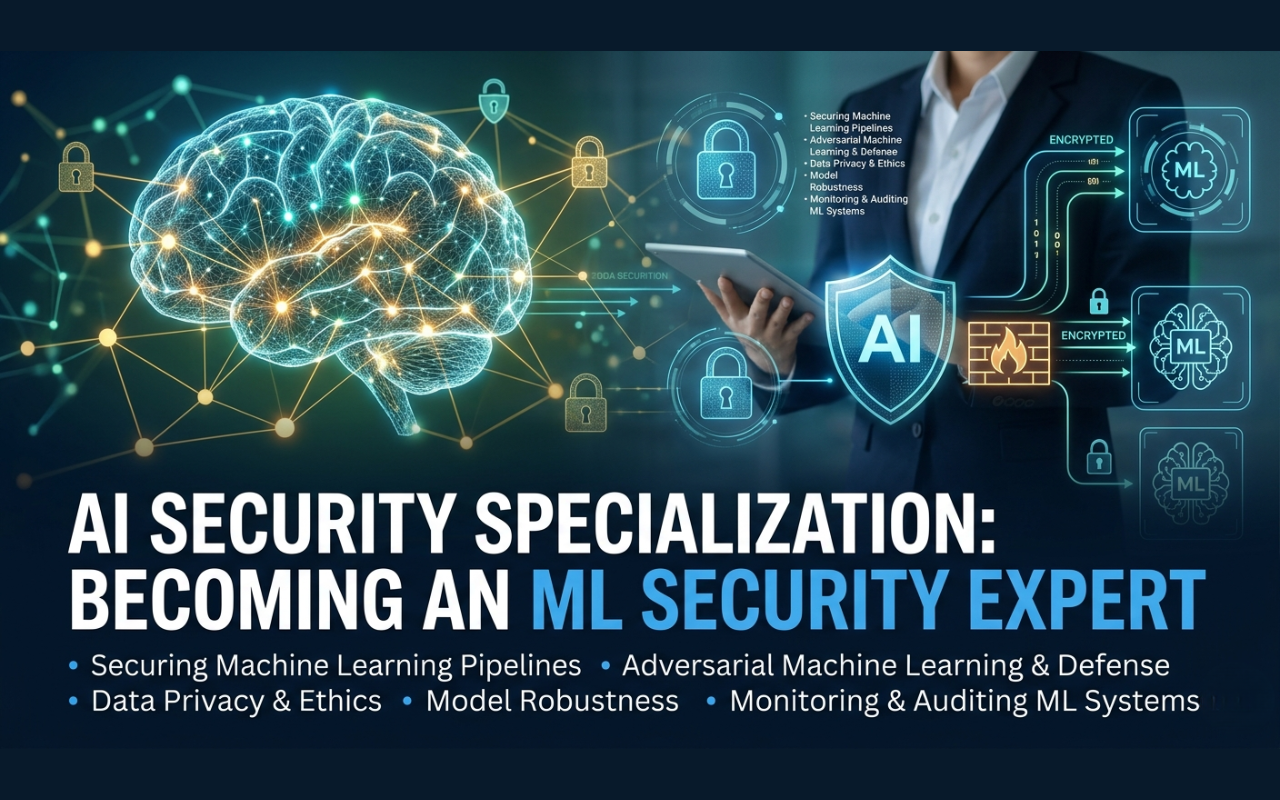
Artificial intelligence is reshaping every corner of the cybersecurity landscape — and with it, an entirely new class of vulnerabilities, attack surfaces, and defensive disciplines has emerged. The demand for professionals who understand both machine learning and security is skyrocketing. This guide breaks down exactly what it takes to specialize in AI security, what skills and certifications matter most, and how to position yourself as an ML security expert in 2026 and beyond.
Why AI Security Is the Hottest Specialization in Cybersecurity Right Now
The integration of artificial intelligence into enterprise infrastructure, critical systems, cloud platforms, and consumer applications has created an attack surface unlike anything the security industry has encountered before. Traditional perimeter defenses, signature-based detection, and legacy vulnerability frameworks were simply not built with machine learning pipelines, foundation models, or neural networks in mind.
According to Gartner, by 2027, more than 40% of all enterprise applications will include some form of embedded AI component. Each of those components introduces potential attack vectors — from model poisoning and adversarial inputs to supply chain vulnerabilities in third-party AI APIs. Security teams with no ML expertise are flying blind.
This gap has created explosive demand for a new kind of cybersecurity professional: the ML Security Expert — someone who bridges the worlds of machine learning engineering, adversarial research, and traditional security operations. If you are considering a specialization that is both technically deep and career-defining, AI security deserves serious attention.
📊 Market SignalRoles titled “AI Security Engineer,” “ML Security Researcher,” and “Adversarial ML Analyst” have grown over 300% on major job boards between 2023 and 2026, with median base salaries exceeding $175,000 at senior levels in North America.
Understanding the AI Security Threat Landscape
Before you can defend AI systems, you need to deeply understand how they are attacked. The AI threat landscape is distinct from conventional application security. Here are the primary threat categories every ML security specialist must master:
🎯 Adversarial Attacks
Carefully crafted inputs designed to fool a model into making incorrect predictions. Includes FGSM, PGD, and C&W attacks on vision and NLP models.
☠️ Model Poisoning
Attackers corrupt training data to embed backdoors or degrade model accuracy. Particularly dangerous in federated learning environments.
🔍 Model Extraction
Querying a model API to reconstruct a functional copy, stealing intellectual property and bypassing licensing controls.
🕵️ Membership Inference
Determining whether specific data records were used in training — a major privacy concern for healthcare and financial AI systems.
💉 Prompt Injection
Embedding malicious instructions in user inputs to hijack the behavior of LLM-powered applications. A critical threat class for AI agents.
📦 Supply Chain Attacks
Compromising pre-trained models, ML frameworks (PyTorch, TensorFlow), or model hubs like Hugging Face to distribute trojanized weights.
Understanding these attack categories is not just theoretical knowledge. In practice, ML security professionals are expected to reproduce these attacks in lab environments, assess production systems for susceptibility, and design countermeasures that do not cripple model performance.
The Core Skill Stack for ML Security Experts
AI security sits at the intersection of multiple disciplines. The professionals who thrive in this space typically have strong foundations in at least two or three of the following domains, and are actively developing competence across all of them:
| Skill Domain | Why It Matters | Priority Level |
|---|---|---|
| Machine Learning Fundamentals | You cannot secure what you do not understand. Supervised, unsupervised, and reinforcement learning are table stakes. | 🔴 Critical |
| Python & ML Frameworks | PyTorch, TensorFlow, scikit-learn, Hugging Face — these are the toolchains of the field. | 🔴 Critical |
| Adversarial ML Research | Deep knowledge of attack types, defenses like adversarial training, and evaluation frameworks like ART and Foolbox. | 🔴 Critical |
| Secure SDLC & DevSecOps | Integrating security into ML pipelines from data ingestion through model deployment and monitoring. | 🟠 High |
| Cloud Security (AWS/GCP/Azure) | Most production ML workloads run on cloud infrastructure. Misconfigured S3 buckets and IAM roles are common model theft vectors. | 🟠 High |
| Privacy-Preserving ML | Differential privacy, federated learning, and homomorphic encryption are increasingly required for regulated industries. | 🟡 Medium |
| LLM Security & Red Teaming | Prompt injection, jailbreaking, and agentic AI risks require specialized offensive knowledge. | 🟠 High |
| Risk Frameworks & Compliance | NIST AI RMF, EU AI Act, and ISO/IEC 42001 are the governance frameworks driving enterprise AI security programs. | 🟡 Medium |
Career Roadmap: From Security Professional to ML Security Expert
Most ML security specialists do not arrive directly from computer science programs. They typically come from a background in either cybersecurity or software/ML engineering, then deliberately build expertise in the other domain. Here is a practical phased roadmap:
Build the ML Foundation
Complete a structured ML course (fast.ai, Andrew Ng’s Coursera Deep Learning Specialization, or Google’s ML Crash Course). Learn Python, NumPy, pandas, and PyTorch or TensorFlow. Understand how classification, regression, NLP, and computer vision models are trained, evaluated, and deployed.
Study Adversarial Machine Learning
Read Goodfellow’s original adversarial examples paper. Experiment with the IBM Adversarial Robustness Toolbox (ART) and Foolbox. Reproduce attacks like FGSM, Carlini-Wagner, and PGD against image classifiers. Study backdoor and data poisoning attacks using Trojan frameworks.
Learn MLSecOps and Secure Deployment
Understand how ML systems are built and deployed in production using MLOps pipelines (MLflow, Kubeflow, SageMaker). Identify the security control gaps at each stage: data sourcing, preprocessing, training, evaluation, serving, and monitoring. Practice threat modeling AI systems using STRIDE and MITRE ATLAS.
Choose a Sub-Specialty
AI security is broad enough to have multiple career niches. Pick one to deepen: offensive AI red teaming, LLM and agentic system security, privacy-preserving ML, AI governance and compliance, or AI-powered threat detection. Begin contributing to open-source security tools and publishing research.
Build Authority and Lead Programs
Present at conferences (DEF CON AI Village, NeurIPS workshops, IEEE S&P). Publish CVEs in ML frameworks. Lead AI red team exercises at your organization. Contribute to standards development through NIST, MITRE, or ISO working groups. Consider founding or advising an AI security startup.
Certifications That Actually Matter for AI Security
The certification landscape for AI security is newer and less standardized than traditional cybersecurity, but several credentials have emerged as meaningful signals of expertise. Here are the ones worth your time and investment:
Emerging AI-Specific Certifications
GIAC GAIL – AI & LLM Security Certified AI Security Professional (CAISP) AWS Certified ML – Specialty Google Professional ML Engineer
Complementary Security Certifications
OSCP – Offensive Security CISSP – Governance & Architecture CCSP – Cloud Security CEH – Ethical Hacking Principles
Privacy & Compliance Credentials
CIPM – Privacy Management ISO/IEC 42001 Lead Auditor
💡 Pro TipIn AI security, demonstrated research and practical projects often outweigh certifications. Building and publishing an adversarial ML attack framework on GitHub, contributing to MITRE ATLAS, or speaking at DEF CON’s AI Village carries significant weight with top employers. Pair certifications with a strong public portfolio.
Key Frameworks and Standards Every ML Security Expert Should Know
AI security is rapidly being formalized into governance and technical frameworks. Fluency in these standards is increasingly expected, especially for professionals working with enterprise clients or in regulated industries:
- MITRE ATLAS (Adversarial Threat Landscape for AI Systems): The definitive taxonomy of AI-specific attack techniques, analogous to MITRE ATT&CK for traditional threats. Study every tactic and technique in ATLAS as a foundational reference.
- NIST AI Risk Management Framework (AI RMF 1.0): The U.S. federal standard for managing AI risks across the model lifecycle. Proficiency here is required for any government or enterprise AI security program.
- EU AI Act: The world’s first comprehensive AI regulation, classifying AI systems by risk level and imposing mandatory security and transparency requirements. If you work with European clients or multinational organizations, this is essential reading.
- ISO/IEC 42001: The international AI management system standard, providing auditability requirements for organizations that develop or use AI systems.
- OWASP Top 10 for LLMs: Maintained by OWASP, this list documents the ten most critical security risks specific to large language model applications — a must-know for any practitioner working with AI-powered products.
- ENISA AI Threat Landscape Report: The European Union Agency for Cybersecurity publishes annual threat intelligence specific to AI systems, covering both attack vectors and defensive best practices.
Salary Expectations for AI Security Specialists in 2026
The combination of ML engineering and security expertise commands some of the highest compensation in the industry. Here is a representative snapshot of U.S.-based compensation ranges by role level:
Where ML Security Experts Work
The industries and organizations actively hiring AI security talent span virtually every sector. Here are the primary employer categories:
- Big Tech and AI Labs: Google DeepMind, Microsoft, Meta, OpenAI, Anthropic, and Amazon all have dedicated AI safety and security teams. These roles are highly competitive but offer unparalleled exposure to frontier systems.
- Cybersecurity Vendors: Companies like CrowdStrike, Palo Alto Networks, Darktrace, and SentinelOne are embedding ML into their products and need experts who can both build and attack AI-powered detection systems.
- Financial Services: Banks, insurance companies, and fintech firms use ML for fraud detection, credit scoring, and trading — all high-value targets with strict regulatory requirements.
- Healthcare and Pharma: Clinical AI for diagnostics, drug discovery, and patient data systems requires privacy-preserving ML and robust model security.
- Government and Defense: Intelligence agencies, defense contractors, and national labs are investing heavily in AI security research and offensive AI capability assessment.
- Consulting and Advisory: Big Four firms and specialized boutiques are building AI security practices to serve enterprise clients navigating AI governance requirements.
Essential Tools and Resources to Build Your Expertise
Hands-On Tools
- IBM Adversarial Robustness Toolbox (ART): Python library for adversarial attack generation, defenses, and certification. The most comprehensive open-source adversarial ML toolkit available.
- Foolbox: Lightweight Python library for running adversarial attacks against neural networks, compatible with PyTorch, TensorFlow, and JAX.
- CleverHans: A Google Brain adversarial example library with implementations of key attack algorithms.
- Garak: An LLM vulnerability scanner for testing prompt injection, jailbreaking, and other generative AI weaknesses.
- PrivacyRaven: A library for executing membership inference and model inversion attacks against production ML models.
Learning Resources
- Adversarial Robustness Toolbox Docs & Tutorials: The ART documentation includes detailed tutorials for each attack and defense category, complete with runnable notebooks.
- MITRE ATLAS Website: Explore the full taxonomy of AI attack techniques with case studies mapped to real-world incidents.
- DEF CON AI Village: Annual track at DEF CON dedicated entirely to offensive and defensive AI security. Recordings are published online and are excellent for staying current.
- arXiv cs.CR and cs.LG: The preprint server where most adversarial ML research is published first. Follow key researchers and set up alert keywords.
- The Security Bench AI Section: Curated coverage of AI and ML security news, analysis, and career guidance tailored for security professionals.
Frequently Asked Questions
Do I need a computer science degree to become an ML security expert?
No. Many successful ML security professionals come from non-traditional backgrounds. What matters is demonstrated competence in both machine learning and security. A strong portfolio of projects, published research, or open-source contributions can carry more weight than a formal degree at many organizations. That said, deep technical roles at research labs often prefer graduate-level ML education.
Should I start from the security side or the ML side?
Either path works, but the most common route is starting with traditional cybersecurity and layering in ML knowledge, because security context shapes how you approach AI vulnerabilities. If you already have an ML engineering background, you have a strong foundation — you will need to add offensive security techniques, threat modeling, and security architecture knowledge.
What is the difference between AI safety and AI security?
AI safety focuses on ensuring AI systems behave as intended and do not cause unintended societal harm — think alignment research, value learning, and interpretability. AI security is narrower and more traditional in its framing: it focuses on adversarial attacks, unauthorized access, model integrity, and data privacy. The disciplines overlap and increasingly inform each other, but they involve different communities and methodologies.
How quickly is this field changing?
Extremely quickly. The shift to LLM-powered applications has introduced an entirely new threat class (prompt injection, agentic risks, RAG poisoning) in just two years. This makes continuous learning non-negotiable. Plan to spend at least a few hours per week reading recent papers, monitoring CVEs in ML frameworks, and experimenting with new tools. Professionals who stay current compound their expertise advantage significantly.
Are there good communities for ML security practitioners?
Yes. The DEF CON AI Village community, the MITRE ATLAS contributor group, and the Adversarial Robustness Toolbox GitHub are active hubs. On social platforms, following researchers from CMU CyLab, MIT CSAIL, and Google DeepMind on LinkedIn or X will surface the most important developments. The OWASP LLM Top 10 project is also an active working group worth joining.
Final Thoughts: Positioning Yourself for the AI Security Era
AI security is not a future specialization — it is an urgent present-day need. Organizations deploying machine learning systems are doing so faster than they can build the internal expertise to secure them. The professionals who invest now in adversarial ML knowledge, secure MLOps practices, and fluency in frameworks like MITRE ATLAS and the NIST AI RMF will find themselves at the center of one of the most critical and well-compensated disciplines in the industry.
The path is not simple. It requires sustained investment across two demanding fields simultaneously. But the compounding returns — in career opportunity, compensation, and impact — make AI security one of the most rewarding specializations available to today’s cybersecurity professional.
Start building your foundation today. The window to establish early expertise in this field is still open, but it will not stay open forever.