

Introduction
Application security (AppSec) has moved from a niche specialization to a core cybersecurity competency. As organizations accelerate digital transformation, adopt cloud-native architectures, and increasingly rely on AI-generated code, the attack surface within applications has expanded dramatically.
Modern security breaches are rarely caused by exotic zero-day exploits alone. More often, they stem from insecure code, misconfigured components, weak authentication logic, or vulnerabilities introduced early in the software development lifecycle (SDLC). This makes application security skills essential not only for security teams, but also for developers, architects, and technology leaders.
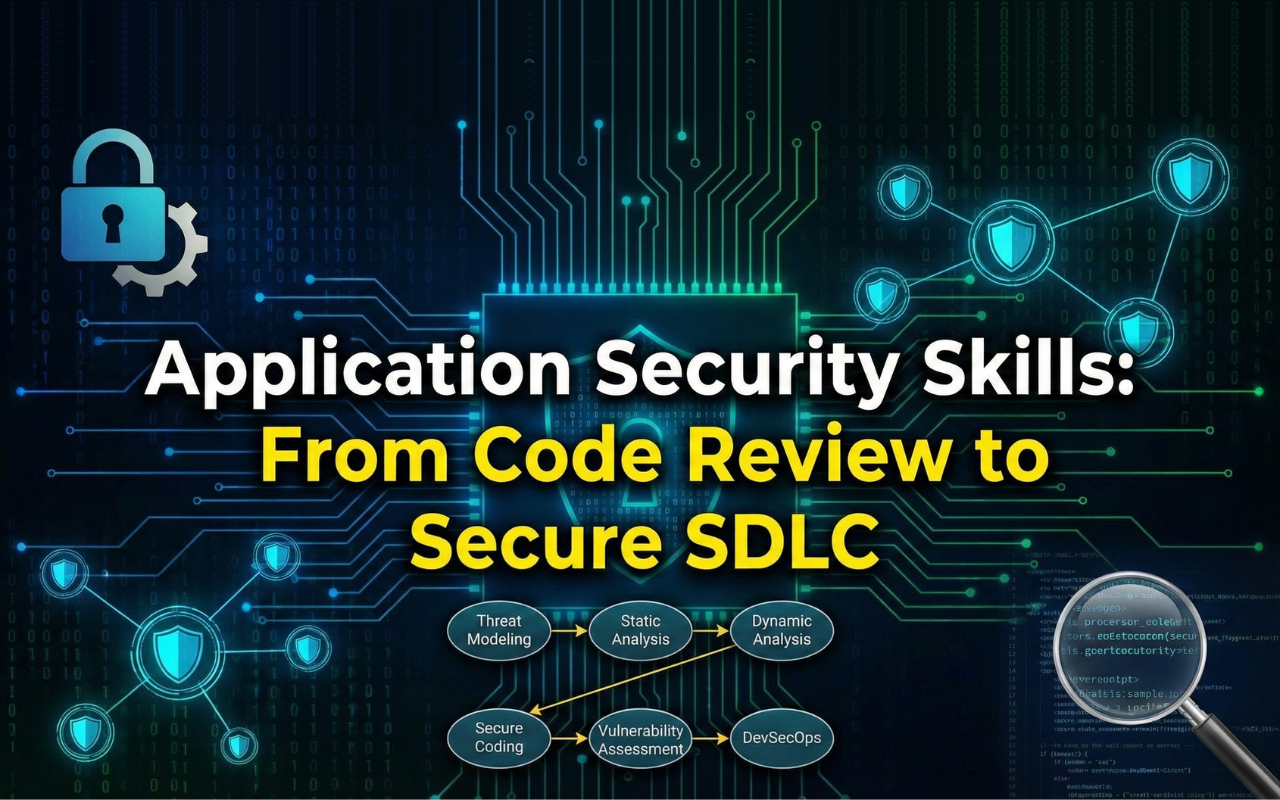
This guide provides a comprehensive overview of application security skills—from hands-on code review to building a mature Secure SDLC—while addressing the emerging risks introduced by AI-assisted development.
Why Application Security Skills Matter More Than Ever
Applications are now the primary interface between organizations and their customers, partners, and employees. According to industry reports, application-layer attacks consistently rank among the top causes of data breaches.
Several trends are driving the need for stronger AppSec skills:
- Rapid release cycles driven by Agile and DevOps practices
- Open-source dependency sprawl and third-party libraries
- Cloud and API-first architectures
- AI-generated and low-code development, which can introduce insecure patterns at scale
Without embedded application security expertise, vulnerabilities often reach production faster than security teams can respond.
Core Application Security Skill Areas
1. Secure Coding Fundamentals
Secure coding is the foundation of application security. Professionals must understand how common vulnerabilities arise and how to prevent them during development.
Key secure coding skills include:
- Understanding the OWASP Top 10 (e.g., injection, broken authentication, insecure deserialization)
- Input validation and output encoding
- Secure authentication and session management
- Proper error handling and logging
- Cryptographic best practices for data at rest and in transit
These principles apply across programming languages, frameworks, and platforms.
2. Code Review and Manual Analysis
Automated tools are valuable, but manual code review remains a critical skill—especially for business logic flaws that tools often miss.
Effective code review skills involve:
- Identifying insecure logic flows
- Reviewing authorization checks and access controls
- Detecting hardcoded secrets or weak cryptographic usage
- Understanding how data flows through the application
Security-focused code reviews are most effective when performed collaboratively with development teams rather than as a last-minute gate.
3. Static Application Security Testing (SAST)
SAST tools analyze source code or compiled binaries to identify potential vulnerabilities early in the SDLC.
Key SAST-related skills include:
- Selecting appropriate tools for language and framework stacks
- Tuning rulesets to reduce false positives
- Integrating SAST into CI/CD pipelines
- Interpreting findings in a development-friendly way
SAST is most valuable when used continuously rather than as a one-time scan.
4. Dynamic Application Security Testing (DAST)
DAST focuses on testing running applications from an attacker’s perspective.
Professionals skilled in DAST understand:
- How to configure scans for authenticated and API-based applications
- Limitations of black-box testing
- Interpreting results in the context of application architecture
- Combining DAST with manual testing for higher accuracy
DAST complements SAST by identifying runtime issues such as misconfigurations and authentication weaknesses.
5. Interactive and Software Composition Analysis (IAST & SCA)
Modern AppSec programs also rely on:
- IAST, which analyzes applications from within during runtime
- SCA, which identifies vulnerabilities in open-source dependencies
Skills in this area include:
- Managing dependency risk and patch prioritization
- Understanding software supply chain threats
- Evaluating license and compliance implications
With most applications relying heavily on third-party components, SCA is now a core AppSec competency.
Threat Modeling and Secure Design
Threat modeling helps teams identify risks before code is written.
Effective threat modeling skills involve:
- Identifying assets, trust boundaries, and attack surfaces
- Using structured approaches such as STRIDE or attack trees
- Designing mitigations aligned with business risk
- Embedding threat modeling into architecture and design reviews
Threat modeling shifts security left, reducing costly rework later in the SDLC.
Building a Secure Software Development Lifecycle (Secure SDLC)
A Secure SDLC integrates security activities into every phase of development:
- Requirements: Define security and privacy requirements early
- Design: Conduct threat modeling and architecture reviews
- Development: Apply secure coding practices and SAST
- Testing: Use DAST, IAST, and manual testing
- Deployment: Secure configurations and secrets management
- Maintenance: Continuous monitoring and vulnerability management
Application security professionals must understand how to align these activities with Agile and DevOps workflows without slowing delivery.
AI-Generated Code: New Risks, New Skills
AI-assisted coding tools have transformed development productivity—but they also introduce unique security challenges.
Common risks include:
- Reproduction of vulnerable code patterns from training data
- Lack of contextual security awareness
- Overconfidence in auto-generated logic
Modern AppSec skills must now include:
- Reviewing AI-generated code with the same rigor as human-written code
- Training developers on secure use of AI coding tools
- Updating security testing pipelines to account for AI-driven development
- Establishing governance around acceptable AI usage
AI does not replace AppSec expertise—it amplifies the need for it.
Measuring AppSec Maturity and Success
Strong application security programs rely on meaningful metrics, such as:
- Vulnerability density over time
- Mean time to remediate (MTTR)
- Percentage of security issues caught pre-production
- Developer engagement and security training completion
These metrics help demonstrate ROI and guide continuous improvement.
Conclusion
Application security skills now span far beyond finding bugs. They require a deep understanding of development practices, tooling, secure design, and emerging technologies like AI.
By building expertise across code review, automated testing, threat modeling, and Secure SDLC implementation, organizations can reduce risk without sacrificing speed. For security professionals, mastering AppSec is no longer optional—it is a foundational capability for protecting modern digital environments.
As applications evolve, so must the skills used to secure them.