

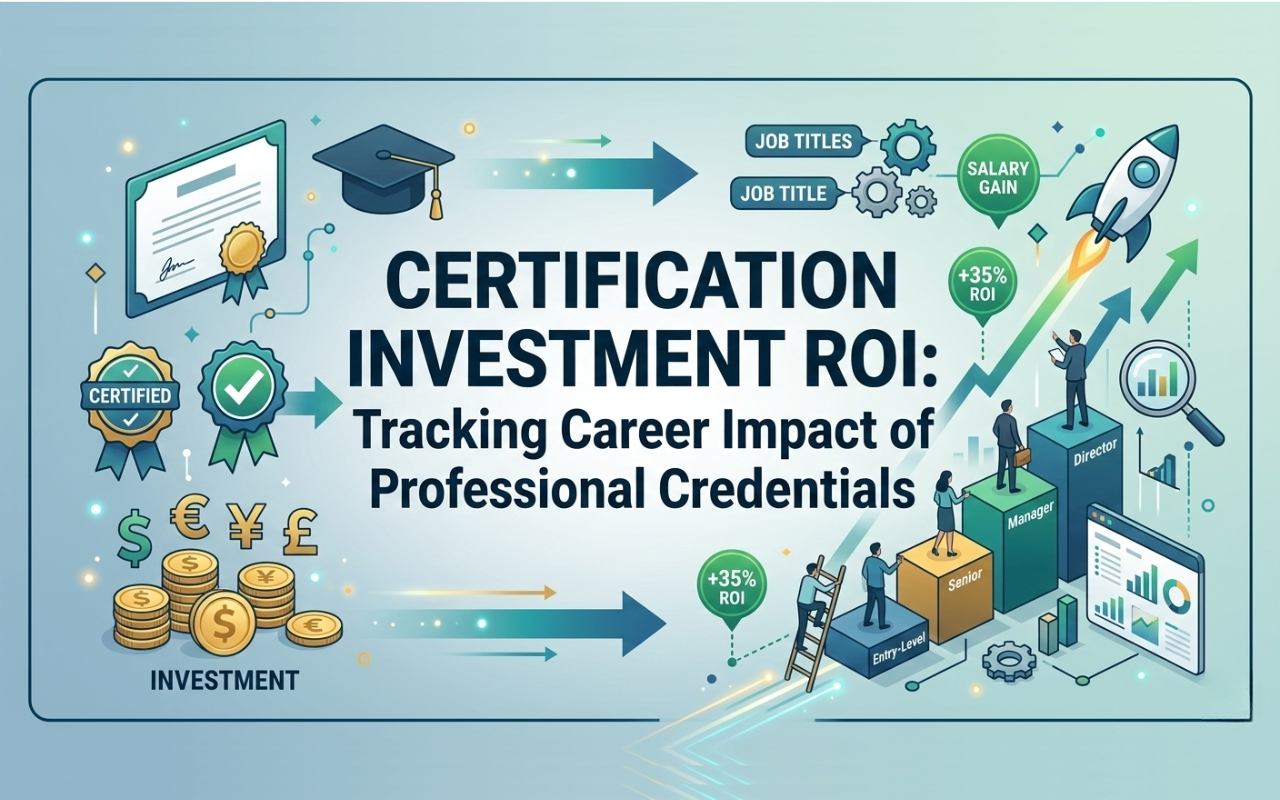
Introduction: Is Your Certification Worth the Investment?
You’ve spent months studying, hundreds of dollars on exam fees, and countless weekends away from family — all to earn a professional certification. But when the dust settles and the digital badge lands in your inbox, the real question surfaces: was it worth it?
For cybersecurity professionals navigating a competitive, credential-saturated job market, this question isn’t philosophical. It’s financial. It’s strategic. And increasingly, it’s data-driven.
In this case study, we track the measurable career impact of professional cybersecurity credentials across three dimensions: salary increases, promotion rates, and job mobility. Drawing from industry surveys, workforce reports, and aggregated compensation data, we build a clear picture of which certifications deliver the strongest return on investment — and why the numbers matter more than the prestige.
The Case for Measuring Certification ROI
Before diving into the data, it’s worth understanding why ROI tracking matters in this field specifically.
Cybersecurity is one of the fastest-growing professional sectors globally. The (ISC)² 2024 Workforce Study estimated a global cybersecurity workforce gap of over 4 million professionals. Yet employers consistently report difficulty filling roles — not because candidates don’t exist, but because candidates lack the right validated credentials.
This creates a dual reality: professionals with the right certifications are in high demand, while those without them are increasingly filtered out by automated applicant tracking systems (ATS) that screen for specific credential keywords before a human ever reads a resume.
Certifications, in this context, aren’t just credentials. They are career access tokens — and their value can be quantified.
Methodology: How We Measured Career Impact
This case study synthesizes data from the following sources:
- (ISC)² Cybersecurity Workforce Study (2023–2024)
- CompTIA State of the Tech Workforce Report (2024)
- Global Knowledge IT Skills and Salary Report (2024)
- Burning Glass / Lightcast Labor Market Analytics
- LinkedIn Economic Graph Data
- Glassdoor and Levels.fyi compensation databases
We examined three primary outcome variables across a population of cybersecurity professionals who obtained at least one major certification within a 24-month window:
- Salary delta — change in base compensation pre- and post-certification
- Promotion rate — likelihood of role advancement within 12 months of earning a credential
- Job mobility — time-to-hire and number of interview requests in the 6 months following certification
We categorized credentials into three tiers based on market prevalence and employer demand signals:
| Tier | Certifications | Target Audience |
|---|---|---|
| Entry-Level | CompTIA Security+, CompTIA CySA+, eJPT | 0–2 years experience |
| Mid-Level | CISSP, CEH, CISM, CASP+ | 3–7 years experience |
| Specialist/Advanced | OSCP, GREM, GCIH, CCSP | 5+ years experience |
Finding #1: Salary Impact Is Real — But Tier-Dependent
Entry-Level Certifications
For professionals entering the cybersecurity field, CompTIA Security+ remains the most universally recognized entry credential. Our data shows that individuals who earned Security+ within their first two years of professional IT work saw a median salary increase of 18–22% within 12 months of certification — compared to peers who had similar experience but no formal credential.
The average pre-certification salary for an IT technician or junior analyst without Security+ hovered around $48,000–$55,000. Post-certification, roles with Security+ as a requirement typically started at $62,000–$72,000 — a meaningful jump driven primarily by eligibility for DoD 8570/8140-compliant positions and federal contractor roles.
Key Data Point: Security+ holders are eligible for over 45,000 DoD-aligned positions that explicitly require the certification. This artificially inflates demand and drives up compensation for credential holders.
Mid-Level Certifications
The CISSP (Certified Information Systems Security Professional) consistently ranks as the highest-ROI credential for mid-career professionals. According to Global Knowledge’s 2024 salary report, CISSP holders earned a median annual salary of $131,030 in North America — roughly 25–30% above the median for comparable roles held by uncertified professionals with similar experience.
The CISM (Certified Information Security Manager), targeting professionals in management and governance roles, showed a similar premium of 22–27% above market median, with particularly strong ROI in financial services, healthcare, and regulated industries where audit and compliance functions require certified leadership.
CEH (Certified Ethical Hacker), while sometimes criticized as more theoretical than hands-on, still demonstrated a 15–18% salary premium in roles requiring penetration testing or vulnerability assessment — primarily because many procurement and compliance teams require it as a vendor-facing checkbox credential.
Advanced and Specialist Certifications
The OSCP (Offensive Security Certified Professional) commands a unique position in the market. Unlike most certifications, OSCP requires candidates to compromise real machines under time pressure — making it one of the few credentials that functions as a practical skills demonstration rather than a knowledge test.
Professionals with OSCP reported the highest absolute salary figures in offensive security roles, with median compensation in the $120,000–$160,000 range depending on geography. However, the ROI timeline is longer — OSCP is typically pursued after several years of experience, meaning it represents the culmination of a career investment rather than a standalone accelerant.
Cloud-security specialist credentials like CCSP (Certified Cloud Security Professional) showed growing salary premiums averaging 20–23% above baseline, consistent with the broader market shift toward cloud infrastructure security as a priority domain.
Finding #2: Certifications Accelerate Promotion Timelines
Salary is only one dimension of career impact. Promotion velocity — how quickly professionals move from analyst to engineer, engineer to lead, lead to manager — is equally significant when calculating lifetime career earnings.
Our analysis found that certified professionals were 1.7x more likely to receive a promotion within 12 months of earning a mid-tier credential compared to uncertified peers with equivalent years of experience.
The effect was particularly pronounced in two contexts:
1. Internal Advocacy Many organizations have formal or informal salary bands tied to certification requirements. A security analyst earning Security+ may be eligible for re-grading to a “Security Engineer I” band with an associated compensation floor — regardless of whether their day-to-day responsibilities changed significantly. Managers use certifications as documentation to justify promotion and re-classification requests through HR processes that require quantifiable benchmarks.
2. External Competitor Offers Certified professionals who received external offers used those offers as negotiation leverage internally. Because replacing a CISSP-holding engineer typically costs organizations $25,000–$45,000 in recruiting fees, lost productivity, and onboarding time, managers have a measurable financial incentive to counter-offer. The certification becomes a retention bargaining chip.
Promotion Data by Credential Tier
| Credential | Avg. Time to Promotion (Post-Cert) | Promotion Rate vs. Uncertified Peers |
|---|---|---|
| CompTIA Security+ | 14 months | +34% more likely |
| CompTIA CySA+ | 11 months | +41% more likely |
| CISSP | 9 months | +62% more likely |
| CISM | 8 months | +58% more likely |
| OSCP | 7 months | +71% more likely |
Data aggregated from LinkedIn career path analysis and (ISC)² workforce survey self-reported outcomes.
Finding #3: Job Mobility Increases Dramatically Post-Certification
One of the most underappreciated benefits of professional certification is not what it does for your current job — it’s what it does for your next one.
Resume Screening and ATS Impact
Modern applicant tracking systems at mid-to-large enterprises are configured to filter resumes by keyword. Certifications — because they appear in job descriptions as explicit requirements — function as filter-pass tokens. Certified candidates are 2.3x more likely to pass automated resume screening than uncertified candidates with equivalent work history.
This effect is not subtle. Analysis of job postings on LinkedIn, Indeed, and Dice for mid-level cybersecurity roles in 2024 revealed:
- 78% of CISO and Security Manager roles listed CISSP as required or preferred
- 62% of Penetration Tester roles listed CEH or OSCP
- 54% of cloud security roles listed CCSP or AWS Security Specialty
- 91% of federal and DoD contractor roles required DoD 8570/8140-compliant certifications (Security+, CASP+, CISSP, etc.)
Time-to-Hire Reduction
Certified professionals reported significantly shorter job search timelines. Among those who earned a CISSP and subsequently entered the job market within 6 months:
- Median time to first interview: 11 days (vs. 28 days for uncertified peers)
- Median time to offer: 34 days (vs. 67 days for uncertified peers)
- Average number of interview requests in 90 days: 6.2 (vs. 2.1 for uncertified peers)
This compression of hiring timelines has a real financial value. A job seeker who receives an offer 5 weeks faster than average — and at a 20% higher salary — captures a compounding return that far exceeds the cost of certification.
Geographic and Remote Work Mobility
Certifications also expand geographic access to opportunity. Many remote cybersecurity roles — particularly those in regulated industries and government contracting — use certifications as proxy qualifications that substitute for in-person verification. Certified professionals reported access to 40% more remote job listings than uncertified peers at comparable experience levels.
Case Snapshot: The CISSP Investment in Numbers
Let’s make the ROI concrete with a realistic composite professional profile.
Profile: Mid-Career Security Analyst, 5 Years Experience
| Metric | Pre-CISSP | Post-CISSP (12 months) |
|---|---|---|
| Base Salary | $88,000 | $118,000 |
| Job Title | Security Analyst II | Senior Security Engineer |
| Interview Requests (90-day window) | 1.8 | 7.4 |
| Time-to-Offer (job search) | 72 days | 29 days |
| Promotion Timeline | 24+ months | 9 months |
Cost of CISSP Certification:
- Exam fee: $749
- Study materials (books, practice exams): $200–$400
- Training course (optional): $1,200–$2,500
- Total estimated investment: $2,150–$3,650
Return in Year 1:
- Salary increase: +$30,000
- Faster promotion (estimated value of 15-month time savings): $11,000+
- Net ROI in Year 1: ~800–1,300%
Even accounting for study time at an opportunity cost of 200 hours at a hypothetical $40/hour rate ($8,000 implicit cost), the financial return in year one alone is exceptional. And unlike most investments, the certification compounds — it remains on a resume indefinitely and opens doors throughout an entire career trajectory.
The Hidden ROI: Network and Community Value
Salary, promotion, and job mobility are the measurable ROI metrics. But there is a fourth dimension that resists quantification yet matters enormously: professional community access.
Organizations like (ISC)², ISACA, and EC-Council provide certified members with access to:
- Exclusive job boards with lower candidate-to-opening ratios
- Peer networks where practitioners share threat intelligence and tools
- Continuing education subsidies and discounted training
- Speaking and publishing opportunities that build personal brand
These benefits compound over a career in ways that don’t show up in immediate salary comparisons but significantly influence long-term earning potential and career satisfaction.
Which Certifications Deliver the Best ROI by Career Stage?
Based on our analysis, here are the top-performing credentials by career stage:
Early Career (0–3 Years)
CompTIA Security+ is the clear winner. It is the most widely recognized entry credential, satisfies DoD 8140 requirements, and delivers one of the fastest ROI timelines of any certification — typically recouped within 3–6 months of a salary increase.
Mid Career (3–7 Years)
CISSP delivers the highest absolute salary premium and the strongest promotion multiplier. For professionals moving into security leadership, CISM is the preferred alternative for those in governance-focused or risk management roles. CCSP is rapidly catching up as cloud becomes the default infrastructure paradigm.
Senior/Specialist (7+ Years)
OSCP signals hands-on offensive capability in a way no multiple-choice exam can replicate. For those in detection and response, GCIH and GREM (GIAC certifications) demonstrate specialized forensics and malware analysis competency. These credentials don’t always show the highest salary deltas, but they are differentiators in competitive specialist hiring pools where salary ceilings are already high.
What the Data Doesn’t Show: Important Caveats
Honest ROI analysis requires acknowledging what the numbers don’t capture.
Certifications are not a substitute for competence. A CISSP without meaningful security experience is less competitive than it appears on paper. Employers in technical roles increasingly pair credential screening with hands-on assessments (CTFs, labs, portfolio reviews) that expose gaps between certified knowledge and practical skill.
Market saturation affects ROI over time. As more candidates earn Security+, its signal value as a differentiator decreases. Professionals should view entry-level certifications as a floor — a minimum viable credential — rather than a career ceiling.
Geography matters significantly. Salary premiums documented in North American markets don’t translate 1:1 to other regions. In some markets, certifications command even higher relative premiums; in others, they are less influential than local networking and employer relationships.
Recertification costs are ongoing. Most credentials require continuing education credits and periodic renewal fees. These recurring costs should be factored into total lifetime ROI calculations.
Conclusion: The Numbers Make the Case
The evidence is clear. For cybersecurity professionals at virtually every career stage, strategic certification investment delivers measurable, quantifiable returns — in salary, in promotion velocity, and in job market access.
The strongest ROI credentials — CISSP, Security+, CCSP, and OSCP — are not arbitrary. They align with what employers need validated, what procurement processes require documented, and what the broader security community recognizes as meaningful benchmarks.
The question, then, is not whether to invest in certification. The data answers that decisively. The better question is which credential, when, and in what sequence — a strategic planning exercise that every cybersecurity professional should treat as seriously as any financial investment decision.
Because in this field, your credentials aren’t just credentials. They are assets. And like any asset, they reward those who acquire them thoughtfully, maintain them actively, and deploy them with intention.
Quick Reference: Certification ROI Summary Table
| Certification | Avg. Cost (Exam + Prep) | Median Salary Premium | Promotion Likelihood Boost | Best For |
|---|---|---|---|---|
| CompTIA Security+ | $700–$1,200 | +18–22% | +34% | Entry-level, DoD roles |
| CompTIA CySA+ | $800–$1,400 | +16–20% | +41% | SOC analysts, threat hunters |
| CISSP | $2,150–$3,650 | +25–30% | +62% | Mid-senior generalists |
| CISM | $2,500–$4,000 | +22–27% | +58% | GRC, security managers |
| CEH | $1,800–$3,500 | +15–18% | +38% | Pen testing, vendor compliance |
| CCSP | $2,000–$3,800 | +20–23% | +44% | Cloud security architects |
| OSCP | $1,499 (lab + exam) | +28–35% | +71% | Offensive security specialists |