

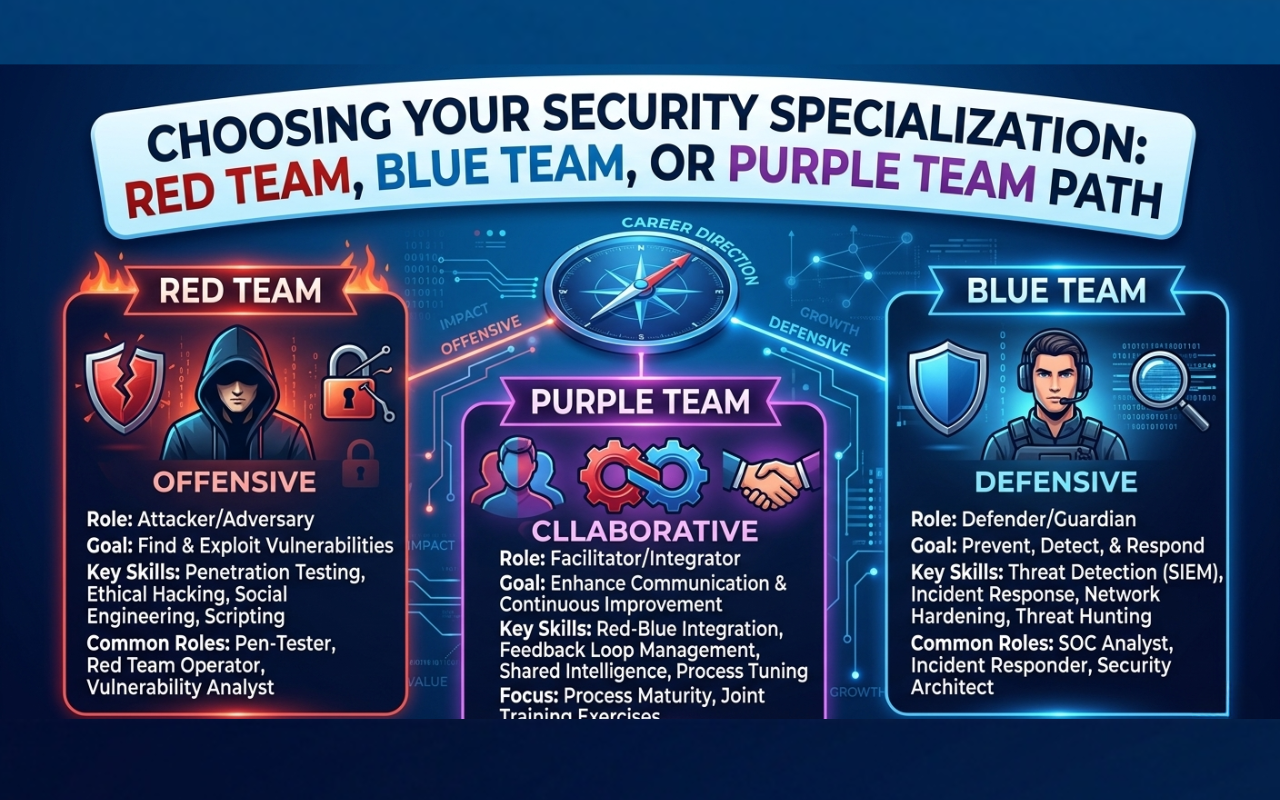
When you first step into the cybersecurity field, one of the most important — and most confusing — decisions you’ll face is choosing a specialization. The industry is vast, the acronyms are endless, and job titles seem to multiply every year. But beneath the noise, three fundamental orientations shape how security teams operate: Red Team, Blue Team, and the increasingly vital Purple Team.
Understanding these roles isn’t just useful trivia. It directly determines which certifications you pursue, which labs you build, how you frame your résumé, and ultimately, which day-to-day work you’ll be doing for the majority of your career. This guide breaks each path down thoroughly — covering the mindset, responsibilities, essential skills, career progression, and certifications that define each role.
The Red Team Path: Thinking Like an Attacker
Red Teaming is the art of simulating real-world adversaries to expose weaknesses in an organization’s defenses before actual threat actors do. Red Team professionals — often called penetration testers, ethical hackers, or offensive security engineers — are tasked with thinking like criminals while working within strict legal and ethical boundaries.
This isn’t just about running automated vulnerability scanners. Elite red teamers combine deep technical knowledge with creativity, persistence, and social engineering acumen. They craft attack scenarios that mirror real APT (Advanced Persistent Threat) tactics, techniques, and procedures (TTPs), following frameworks like MITRE ATT&CK to ensure their simulations reflect the actual threat landscape.
- Conducting network, web application, and API penetration tests
- Performing physical security assessments and social engineering engagements
- Developing custom exploits and evasion techniques for advanced campaigns
- Simulating full attack chains from initial access to lateral movement and exfiltration
- Writing detailed technical reports with evidence and remediation recommendations
- Red Team operations: multi-week adversary simulations aligned to specific threat actors
The Red Team Mindset
What separates a good penetration tester from a great one isn’t purely technical skill — it’s curiosity and persistence. Red teamers are inherently suspicious of accepted assumptions. When a system is labeled “secure,” their instinct is to ask “secure from what?” They thrive on puzzles, enjoy discovering how things break, and take genuine satisfaction in uncovering what others missed.
If you find yourself instinctively looking for loopholes, enjoy CTF (Capture the Flag) competitions, or have ever wondered “what happens if I try this?” in a system context, the Red Team path may be your natural habitat.
Key Certifications for Red Teamers
Red Team Certifications (Entry → Advanced)
- CompTIA PenTest+— Entry-level; validates core penetration testing concepts
- CEH (Certified Ethical Hacker)— Vendor-neutral; widely recognized for beginners
- OSCP (Offensive Security Certified Professional)— Industry gold standard; rigorous 24-hour exam
- CRTO (Certified Red Team Operator)— Focused on red team ops and C2 frameworks like Cobalt Strike
- OSED / OSEP (Offensive Security)— Advanced exploit development and evasion
- GPEN / GWAPT (GIAC)— Respected enterprise-level credentials
💡Career Tip: The OSCP remains the most widely respected entry into professional penetration testing. Its hands-on, exam-under-pressure format signals to employers that you can actually hack, not just recite theory. Build your lab environment and practice on platforms like HackTheBox, TryHackMe, and PentesterLab before attempting it.
Red Team Career Progression
Most red teamers begin as junior penetration testers, assisting on assessments and writing report sections. Over time, they lead their own engagements, specialize in areas like web applications, Active Directory attacks, or hardware hacking, and eventually may progress to Senior Penetration Tester, Red Team Lead, or Director of Offensive Security. Some of the most experienced professionals move into adversary simulation roles or offensive security consulting at global firms.
The Blue Team Path: Defending the Perimeter and Beyond
Blue Teamers are the defenders. They monitor, detect, analyze, and respond to threats targeting their organization’s systems, networks, and data. While the red team asks “how do I break in?”, the blue team asks “how would I know if someone already did?”
Blue Team work is fundamentally reactive in nature — but the best blue team professionals are proactive. They don’t just wait for alerts; they hunt for threats, fine-tune detection logic, build playbooks, and harden systems before attackers ever arrive. In many organizations, the Security Operations Center (SOC) is the heartbeat of the blue team function.
- Monitoring security events via SIEM platforms (Splunk, Microsoft Sentinel, IBM QRadar)
- Triaging, investigating, and escalating security alerts
- Leading incident response and forensic investigation during active breaches
- Developing and tuning detection rules, correlation logic, and SOAR playbooks
- Conducting threat hunting to proactively identify hidden intrusions
- Managing endpoint detection and response (EDR) tools and vulnerability management programs
The Blue Team Mindset
Blue team professionals are often methodical, analytical, and detail-oriented. They’re comfortable with ambiguity — not every alert tells a clear story, and piecing together an attack narrative from fragmented log data requires patience and structured thinking. The best defenders are also deeply curious about how attacks work, because understanding attacker behavior is the foundation of effective detection.
If you enjoy pattern recognition, log analysis, problem-solving under pressure, and the satisfaction of neutralizing a threat before it causes damage, the Blue Team path is likely a strong fit.
Key Certifications for Blue Teamers
Blue Team Certifications (Entry → Advanced)
- CompTIA Security+— The foundational baseline; widely required by employers
- CompTIA CySA+ (Cybersecurity Analyst)— Focused on SOC analysis and threat intelligence
- Blue Team Labs Online (BTLO) / TryHackMe SOC Path— Hands-on platforms for practical skills
- GCIH (GIAC Certified Incident Handler)— Strong credential for incident response professionals
- GCFE / GCFA (GIAC Forensics)— Digital forensics and memory analysis
- Microsoft SC-200 / Splunk Core Certified— Platform-specific SIEM credentials
Blue Team Career Progression
Entry-level blue teamers typically start as Tier 1 SOC Analysts — triaging high-volume alerts and escalating confirmed incidents. With experience, they advance to Tier 2 (investigation and deeper analysis), Tier 3 (threat hunting and advanced IR), and eventually roles like Security Engineer, Threat Intelligence Analyst, Incident Response Manager, or CISO track leadership positions. The blue team career ladder is long and well-structured, with strong demand across virtually every industry vertical.
The Purple Team Path: Bridging Offense and Defense
The Purple Team is the most misunderstood of the three — and arguably the most strategically valuable. Purple teaming isn’t a separate department you join; it’s a collaborative model where red and blue team professionals work side-by-side to improve an organization’s overall security posture. The goal is knowledge transfer, not competition.
In a mature purple team engagement, red teamers execute specific attack techniques while blue teamers watch in real time, adjusting detection logic and testing whether their tools and processes actually catch what they’re supposed to. The result is faster improvement on both sides — red learns what’s being monitored, blue learns what’s actually happening during attacks.
- Facilitating structured, collaborative red vs. blue exercises (purple team assessments)
- Mapping attack scenarios to the MITRE ATT&CK framework for coverage analysis
- Using adversary simulation platforms (Atomic Red Team, Caldera, Vectr) to run controlled tests
- Identifying and closing detection gaps in SIEM, EDR, and NDR tooling
- Translating red team findings into actionable blue team detection improvements
- Communicating technical risk to both technical teams and executive stakeholders
The Purple Team Mindset
Purple teamers are translators. They must be technically fluent in both offense and defense — comfortable discussing exploitation techniques and SIEM query optimization in the same breath. But beyond technical skills, they need exceptional communication, collaboration, and facilitation abilities. They often serve as the connective tissue between siloed security teams.
If you enjoy both attacking and defending, love helping others understand complex security concepts, and are energized by collaborative problem-solving rather than solo hacking, the Purple Team path may be your calling.
Key Certifications for Purple Teamers
Purple Team Certifications & Skills
- MITRE ATT&CK Practitioner Certification— Framework-level knowledge essential for purple work
- Certified Purple Team Professional (CPTP)— Emerging credential focused on collaboration methodology
- GDAT (GIAC Defending Advanced Threats)— Detection engineering for advanced threats
- Both red and blue team certs (e.g., OSCP + GCIH)— Dual-track credentialing is highly valued
- Threat Intelligence certs (GCTI, CTIA)— Understanding adversary TTPs at depth
Purple Team Career Progression
Purple team roles are increasingly formalized in larger enterprise security programs. You might see titles like Purple Team Operator, Detection Engineer, Adversary Emulation Specialist, or Threat-Informed Defense Analyst. These roles often command premium salaries because they require experience on both sides of the security divide — and professionals who’ve earned that cross-domain expertise are rare.
Side-by-Side Comparison
| Dimension | 🔴 Red Team | 🔵 Blue Team | 🟣 Purple Team |
|---|---|---|---|
| Primary Goal | Find and exploit vulnerabilities | Detect, respond, and recover | Improve detection through collaboration |
| Core Mindset | Attacker / adversary simulation | Analyst / defender | Translator / bridge-builder |
| Key Tools | Metasploit, Cobalt Strike, Burp Suite, Nmap | Splunk, Sentinel, CrowdStrike, Wireshark | Atomic Red Team, Vectr, Caldera, ATT&CK Navigator |
| Work Style | Project-based, often client-facing | Ongoing operations, shift work possible | Collaborative exercises, cross-team facilitation |
| Entry Cert | CompTIA PenTest+ / CEH | CompTIA Security+ / CySA+ | Security+ + ATT&CK Practitioner |
| Top Cert | OSCP, CRTO, OSED | GCIH, GCFA, GCIA | CPTP, GDAT + cross-domain certs |
| Avg. Demand (2026) | High — especially in consulting | Very High — every org needs defenders | Growing rapidly in enterprise |
| Best Fit For | Creative problem-solvers, CTF enthusiasts | Analytical minds, process-driven thinkers | Communicators who love both worlds |
🧭 Which Team Fits Your Natural Tendencies?
Most security professionals don’t start with a perfectly defined team affiliation — and that’s fine. Many blue teamers develop red team skills over time (and become better defenders for it). Many red teamers transition to purple team or leadership roles after years of offensive work. Your first job is rarely your final specialization. Focus on building foundational skills, get hands-on lab experience, and let your interests guide you as your knowledge grows.
How to Start Your Journey: Practical First Steps
Regardless of which path attracts you most, every cybersecurity professional benefits from a strong foundation. Here’s how to approach your early development strategically.
Build Your Home Lab
Nothing replaces hands-on practice. Set up a virtualized environment using VirtualBox or VMware. Install Kali Linux for offensive tools and Windows Server with Active Directory for a realistic target environment. Practice attacks, then practice detecting them. This dual perspective is invaluable no matter which team you join.
Use Structured Learning Platforms
Platforms like TryHackMe (great for beginners), HackTheBox (more advanced), Blue Team Labs Online (defensive-focused), and LetsDefend (SOC simulation) provide guided, gamified learning paths that accelerate skills faster than self-study alone.
Follow the MITRE ATT&CK Framework
Whether you’re attacking or defending, understanding the MITRE ATT&CK framework is non-negotiable in 2026. It provides a shared taxonomy for describing attacker behavior that both red and blue teams rely on. Familiarize yourself with the tactic and technique categories early in your career.
Network in the Community
The security community is unusually generous with knowledge. Engage on platforms like LinkedIn, follow researchers on X (formerly Twitter), join Discord servers for security communities, attend BSides events (often free), and participate in CTF competitions. Community connections open doors that certifications alone cannot.
Frequently Asked Questions
Final Thoughts: There’s No Wrong Door
The red, blue, and purple team framework isn’t meant to box you in — it’s meant to help you find your footing in a field that can feel overwhelming from the outside. The best security professionals develop fluency in multiple domains over time, and the lines between these teams blur regularly in practice.
What matters most early in your career is choosing a direction, building real skills through hands-on practice, and staying curious. The cybersecurity field rewards continuous learners above all else. Pick the path that makes you want to stay up late practicing — and start moving.
Whether you’re leaning Red, Blue, or Purple: start a home lab this week. Download Kali Linux, spin up a vulnerable VM like Metasploitable or DVWA, and practice both exploiting and detecting. The best security professionals aren’t defined by their certification list — they’re defined by the hours they’ve spent actually doing the work.