

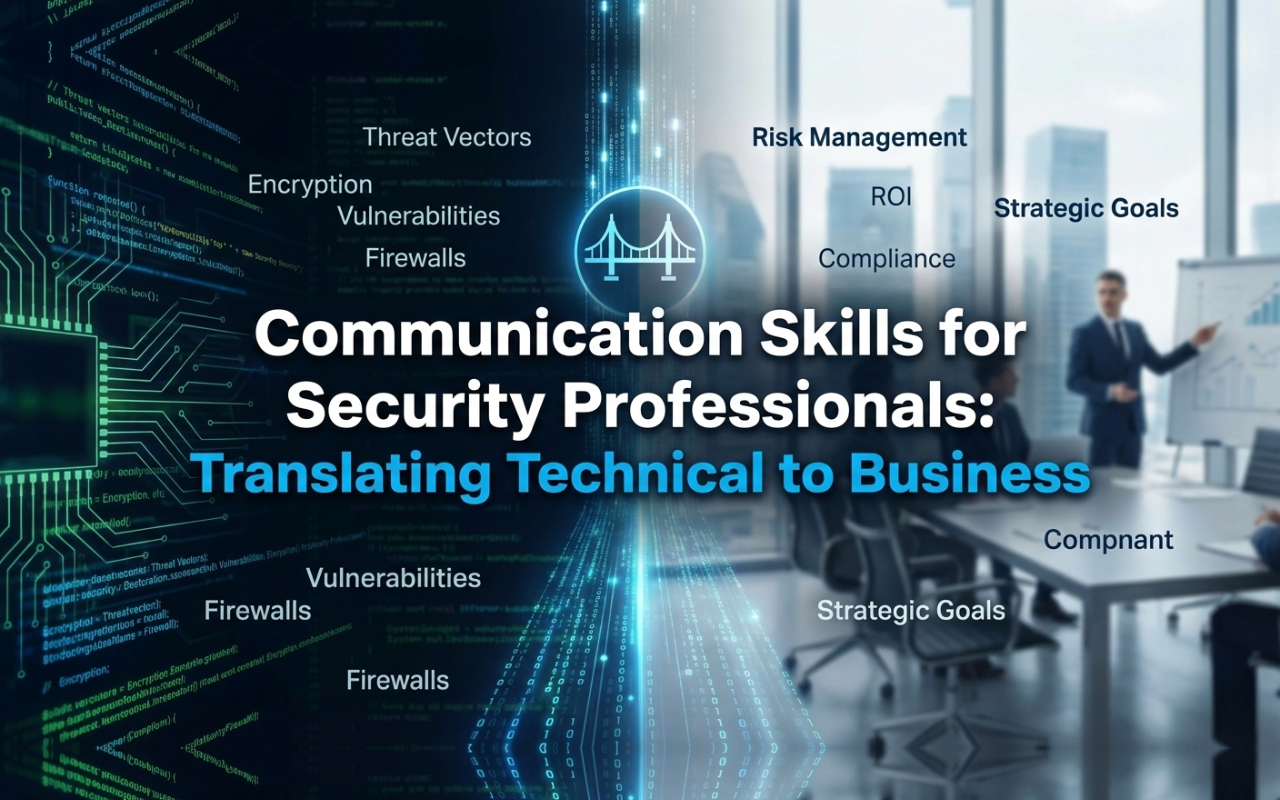
Cybersecurity is no longer just a technical discipline. It is a business-critical function.
Modern security professionals are expected not only to defend infrastructure but also to explain risks, justify budgets, influence leadership, and collaborate across departments.
Technical expertise may get you hired — but communication skills determine how far you advance.
This guide explores how security professionals can develop strong communication skills, translate complex technical risks into business language, and become strategic security leaders.
Why Communication Skills Matter in Cybersecurity
Many security initiatives fail not because of technical limitations, but because of poor communication.
Common challenges include:
-
Executives not understanding cyber risk
-
Business leaders seeing security as a blocker
-
Developers misunderstanding secure coding requirements
-
Budget requests being denied due to unclear value
Security professionals who can clearly communicate risk, impact, and solutions gain credibility and influence.
In 2026, communication is a core cybersecurity skill.
The Gap Between Technical and Business Language
Technical teams often discuss:
-
Vulnerabilities
-
CVSS scores
-
Encryption algorithms
-
Authentication protocols
-
Network segmentation
Executives, however, care about:
-
Financial risk
-
Regulatory impact
-
Operational downtime
-
Brand reputation
-
Competitive advantage
The key skill is translating:
“Critical vulnerability in authentication protocol”
into
“Risk of unauthorized access that could disrupt operations and impact revenue.”
Core Communication Skill #1: Executive Presentations
Presenting to executives requires clarity, brevity, and strategic framing.
How to Communicate with Leadership
-
Focus on risk, not technical details
-
Use business impact metrics
-
Provide clear recommendations
-
Present options with trade-offs
-
Avoid jargon
Example
Instead of saying:
“We detected anomalous lateral movement in the domain environment.”
Say:
“We identified suspicious access behavior that could allow attackers to move deeper into our systems. We recommend immediate containment to reduce operational risk.”
Executives want insight and action — not raw data.
Core Communication Skill #2: Risk Communication
Security is fundamentally about risk management.
Strong security professionals understand how to:
-
Quantify risk in business terms
-
Explain likelihood and impact
-
Connect technical weaknesses to business consequences
-
Avoid fear-based messaging
Use Risk Framing
Effective risk communication answers:
-
What could happen?
-
How likely is it?
-
What would the business impact be?
-
What does mitigation cost compared to potential loss?
Framing risk clearly helps leadership make informed decisions.
Core Communication Skill #3: Cross-Functional Collaboration
Security does not operate in isolation.
Security professionals must collaborate with:
-
Developers
-
IT operations
-
Legal teams
-
Compliance teams
-
Product managers
-
HR
How to Improve Cross-Team Communication
-
Understand other departments’ priorities
-
Speak their language
-
Avoid positioning security as a roadblock
-
Offer solutions, not just restrictions
For example:
Instead of:
“You can’t deploy that — it’s insecure.”
Say:
“We can deploy safely if we implement these controls. Let’s work together to reduce risk.”
Collaboration builds long-term influence.
Core Communication Skill #4: Writing Clear Security Documentation
Written communication is often overlooked.
Security professionals must write:
-
Incident reports
-
Risk assessments
-
Policy documents
-
Audit responses
-
Executive summaries
Best Practices for Security Writing
-
Use simple language
-
Keep sentences concise
-
Avoid unnecessary technical jargon
-
Structure information clearly
-
Highlight key findings
Clear documentation improves credibility and audit readiness.
Core Communication Skill #5: Incident Communication
During a security incident, communication is critical.
Poor messaging can:
-
Create panic
-
Damage reputation
-
Confuse stakeholders
-
Slow response efforts
Strong incident communication includes:
-
Clear timeline
-
Known facts vs. assumptions
-
Business impact assessment
-
Next steps
-
Regular updates
Security leaders must remain calm, structured, and transparent.
Developing Business Acumen as a Security Professional
To translate technical issues effectively, you must understand business fundamentals.
Key areas to learn:
-
Financial impact modeling
-
Regulatory requirements
-
Industry risk landscape
-
Organizational goals
-
Revenue streams
When you understand the business, you can align security initiatives with strategic objectives.
Practical Steps to Improve Communication Skills
Here are actionable steps for security professionals:
1. Practice Simplifying Technical Topics
Explain a complex concept (like Zero Trust or encryption) in plain language.
2. Observe Executive Communication
Watch how leaders present information — note structure and clarity.
3. Take Presentation Opportunities
Volunteer to present in meetings or lead security briefings.
4. Learn Storytelling Techniques
Stories help people understand impact better than raw metrics.
5. Seek Feedback
Ask managers or peers for feedback on clarity and delivery.
Communication improves with practice and intentional effort.
Career Benefits of Strong Communication Skills
Security professionals with strong communication skills often advance into:
-
Security Architect
-
Security Manager
-
CISO roles
-
Risk and Governance leadership
-
Security consulting
Technical skill builds credibility. Communication builds leadership.
In many organizations, communication ability is the differentiator between a senior engineer and a security executive.
The Future of Security Leadership
As cybersecurity becomes increasingly integrated into business strategy, security leaders must:
-
Influence board-level decisions
-
Justify security investments
-
Translate threats into strategic risk
-
Align security with digital transformation
The most successful security professionals are those who combine deep technical expertise with strong communication capabilities.
Final Thoughts
Cybersecurity is no longer just about firewalls, encryption, or detection systems. It is about enabling secure business operations.
By developing executive presentation skills, improving risk communication, strengthening cross-functional collaboration, and mastering clear documentation, security professionals can elevate their impact and career trajectory.
In the modern security landscape, the ability to translate technical complexity into business clarity is not optional — it is essential.