

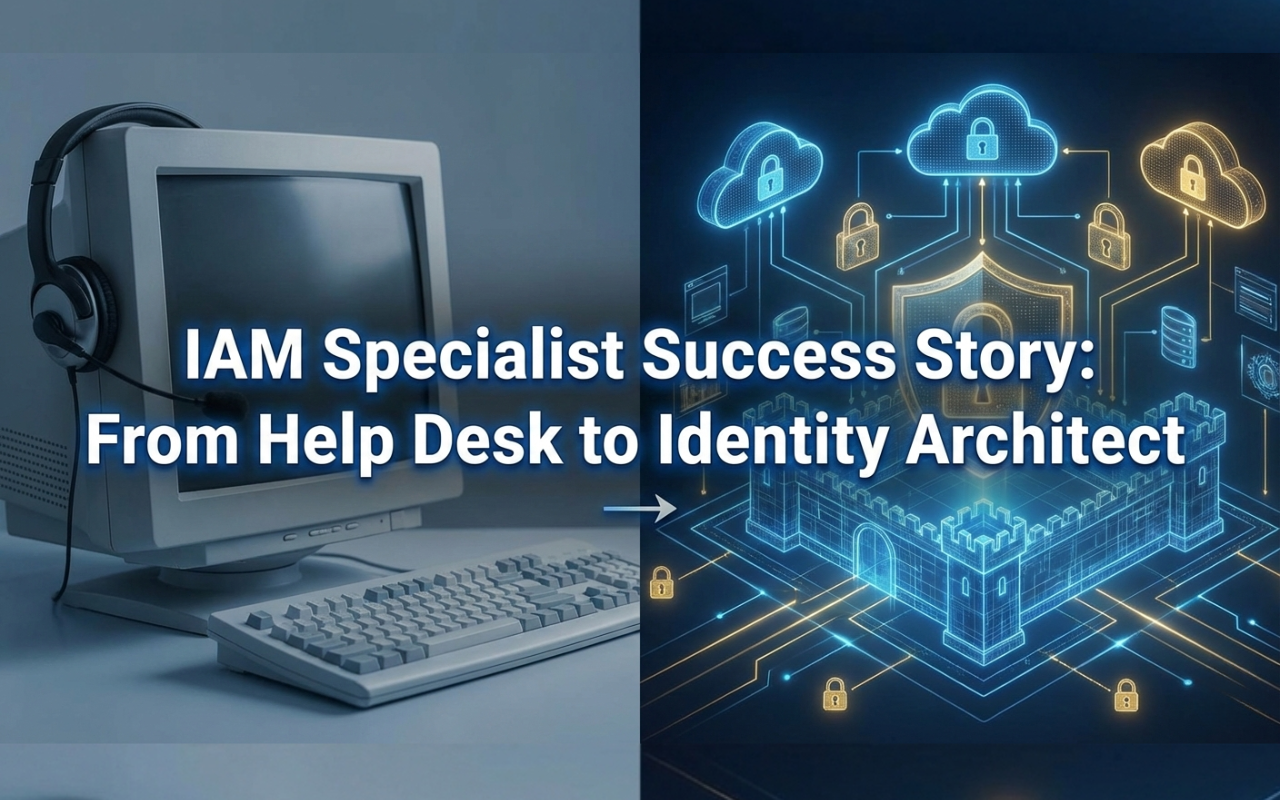
The cybersecurity industry is filled with professionals who did not start in security. Many began in IT support, system administration, or networking before discovering their specialization.
This case study explores how one IT help desk technician successfully transitioned into a highly skilled Identity and Access Management (IAM) Architect, outlining the skills acquired, certifications earned, and strategic career moves that made the transformation possible.
If you’re currently in IT support or early in your cybersecurity career, this roadmap can help you build a future-proof identity security career.
Starting Point: IT Help Desk Technician
Like many professionals, the journey began in an entry-level IT support role.
Core Responsibilities:
-
Password resets and account unlocks
-
Active Directory user provisioning
-
Troubleshooting login issues
-
Supporting MFA enrollment
-
Managing access requests
While these tasks may seem basic, they provided foundational exposure to identity systems and user lifecycle management.
Key Realization:
Repeated password issues and access control problems revealed something important:
Identity was the center of operational security.
That realization became the turning point.
Phase 1: Building IAM Fundamentals
After recognizing identity as a strategic security domain, the next step was skill development.
Technical Skills Acquired:
-
Active Directory architecture
-
Role-Based Access Control (RBAC)
-
Identity lifecycle management (Joiner-Mover-Leaver processes)
-
Group policy management
-
Basic scripting (PowerShell for automation)
Early Certifications:
-
CompTIA Security+
-
Microsoft Identity certifications
-
ITIL Foundation
These certifications validated baseline security knowledge and demonstrated commitment to growth.
Phase 2: Transition to IAM Analyst
Within two years, the technician transitioned into an IAM Analyst role.
Expanded Responsibilities:
-
Managing access governance campaigns
-
Supporting Identity Governance & Administration (IGA) tools
-
Implementing Multi-Factor Authentication (MFA)
-
Assisting with audit requests
-
Reviewing privileged access assignments
This phase focused heavily on understanding:
-
Segregation of duties (SoD)
-
Compliance requirements
-
Audit readiness
-
Risk-based access control
Key Skill Development:
-
Access certification campaigns
-
Identity federation (SAML, OAuth, OIDC)
-
Single Sign-On (SSO) implementation
-
Ticket workflow automation
The shift from reactive support to proactive identity governance marked a major career advancement.
Phase 3: Specializing in Privileged Access Management (PAM)
Recognizing that privileged access posed the highest risk, the professional decided to specialize further.
Advanced Skills Acquired:
-
Privileged Access Management (PAM) implementation
-
Just-In-Time (JIT) access models
-
Session monitoring and recording
-
Privilege elevation workflows
-
Zero Standing Privileges (ZSP) concepts
Certifications Earned:
-
Certified Information Systems Security Professional (CISSP)
-
Certified Identity and Access Manager (CIAM or vendor-specific IAM certifications)
-
Cloud security certifications (Azure/AWS IAM tracks)
This specialization increased both responsibility and earning potential.
Phase 4: Becoming an Identity Architect
After several years of hands-on IAM engineering experience, the professional moved into an Identity Architect role.
Responsibilities as an IAM Architect:
-
Designing enterprise IAM architecture
-
Integrating identity across cloud and on-prem environments
-
Leading Zero Trust initiatives
-
Overseeing passwordless authentication deployment
-
Implementing ITDR (Identity Threat Detection & Response) strategies
At this stage, technical depth was paired with:
-
Strategic thinking
-
Stakeholder communication
-
Policy design
-
Board-level reporting
The role shifted from execution to architecture and leadership.
Skills That Enabled the Career Transformation
This success story highlights key IAM skills that enabled career progression:
Technical Skills
-
Identity lifecycle automation
-
SSO and federation protocols
-
Privileged access controls
-
Cloud IAM configuration
-
Identity threat detection
-
Passwordless authentication
Governance & Compliance Skills
-
Access reviews
-
Audit reporting
-
Risk assessment
-
Policy documentation
Soft Skills
-
Business communication
-
Cross-team collaboration
-
Change management
-
Strategic planning
IAM professionals must combine technical depth with business alignment.
Why IAM Is a Strong Career Path in 2026
Identity has become the new security perimeter.
Organizations are investing heavily in:
-
Zero Trust security
-
Passwordless authentication
-
Privileged access management
-
Identity Threat Detection & Response (ITDR)
This creates sustained demand for IAM professionals at all levels.
Career roles include:
-
IAM Engineer
-
Identity Governance Analyst
-
PAM Specialist
-
Identity Architect
-
IAM Security Consultant
The career path from help desk to architect is achievable with consistent skill development.
Lessons for Aspiring IAM Professionals
This case study reveals several key lessons:
-
Entry-level IT roles provide valuable identity exposure
-
Certifications accelerate credibility
-
Specialization increases career growth
-
Automation skills improve impact
-
Strategic thinking enables leadership roles
Identity security rewards professionals who build both breadth and depth.
Final Thoughts
The journey from help desk technician to IAM Architect demonstrates that cybersecurity careers are not linear — they are built through intentional skill development.
Identity and Access Management remains one of the most stable, high-demand domains in cybersecurity. For IT professionals looking to specialize, IAM offers:
-
Strong career growth
-
High-impact security work
-
Leadership opportunities
-
Long-term industry relevance
With the right certifications, hands-on experience, and continuous learning, transitioning into an Identity Architect role is not just possible. It’s realistic.