

Introduction: The Death of the Traditional Network Perimeter
For decades, network security relied on a simple idea: protect the perimeter and trust everything inside. Firewalls, VPNs, and intrusion detection systems formed the defensive wall around corporate networks.
But today’s environments are dramatically different.
Organizations now operate across:
-
Cloud platforms and SaaS applications
-
Remote and hybrid workforces
-
Mobile and IoT devices
-
Distributed global infrastructure
The traditional perimeter has dissolved. In its place, modern network security focuses on identity, context, and continuous verification rather than location.
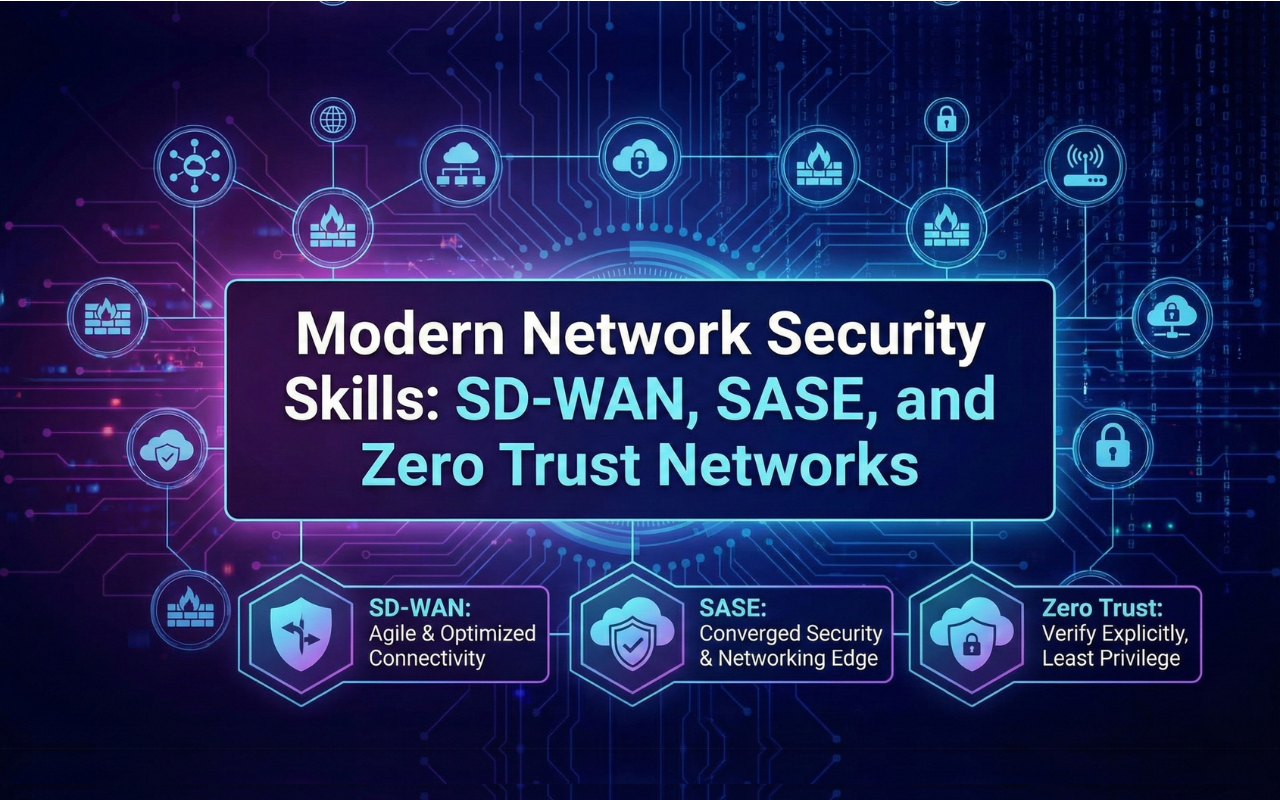
This shift has created demand for professionals skilled in SD-WAN, SASE, and Zero Trust networking—the pillars of cloud-first network security.
Why Network Security Skills Must Evolve
Modern threat actors exploit:
-
Remote access vulnerabilities
-
Misconfigured cloud services
-
Weak identity controls
-
Legacy VPN infrastructure
-
Flat network architectures
Organizations need network security professionals who understand how modern connectivity works and how to secure it.
Key modern security goals include:
-
Secure access from anywhere
-
Minimize attack surface
-
Reduce lateral movement
-
Improve visibility and control
-
Enable business agility without sacrificing protection
Understanding Software-Defined WAN (SD-WAN)
What is SD-WAN?
Software-Defined Wide Area Networking (SD-WAN) replaces traditional MPLS-based WAN architectures with software-driven, cloud-aware networking.
Instead of routing traffic through centralized data centers, SD-WAN enables:
-
Direct cloud access
-
Intelligent traffic routing
-
Centralized policy management
-
Real-time network monitoring
Why SD-WAN Matters for Security
Traditional WAN models created:
-
Bottlenecks
-
Poor performance for cloud apps
-
Complex security architectures
SD-WAN improves security by enabling:
1. Encrypted Traffic by Default
Modern SD-WAN solutions encrypt traffic between locations and cloud services.
2. Application-Aware Routing
Traffic is routed based on application priority and risk.
3. Centralized Policy Enforcement
Security policies are applied consistently across all sites and users.
4. Integrated Security Capabilities
Many SD-WAN platforms include:
-
Firewall capabilities
-
Intrusion prevention systems
-
Secure web gateways
Essential SD-WAN Skills
Security professionals should understand:
-
SD-WAN architecture and deployment models
-
Secure site-to-site connectivity
-
Traffic segmentation and policy design
-
Monitoring and troubleshooting SD-WAN environments
Secure Access Service Edge (SASE): Security Meets Networking
What is SASE?
Secure Access Service Edge (SASE) combines networking and security into a unified cloud-delivered platform.
SASE integrates multiple technologies:
-
SD-WAN
-
Secure Web Gateway (SWG)
-
Cloud Access Security Broker (CASB)
-
Firewall as a Service (FWaaS)
-
Zero Trust Network Access (ZTNA)
Instead of securing a location, SASE secures the user, device, and connection.
Why SASE is Transforming Security
Modern organizations need:
-
Secure remote work
-
Scalable cloud access
-
Consistent global policies
-
Reduced infrastructure complexity
SASE delivers security directly from the cloud, enabling secure access from anywhere.
Key SASE Skill Areas
Cloud Security Integration
Understanding how SASE protects SaaS and cloud platforms.
Identity-Driven Access Control
Security policies based on:
-
User identity
-
Device posture
-
Location and behavior
Traffic Inspection and Visibility
Monitoring encrypted traffic without compromising performance.
Vendor Ecosystem Knowledge
Familiarity with major SASE providers and architectures.
Zero Trust Networking: Never Trust, Always Verify
The Core Principle of Zero Trust
Zero Trust assumes:
No user or device should be trusted automatically.
Every access request must be:
-
Authenticated
-
Authorized
-
Continuously validated
Why Zero Trust is Critical Today
Attackers often gain access through:
-
Phishing credentials
-
Compromised devices
-
Third-party vendors
-
Misconfigured cloud services
Once inside, they move laterally across networks.
Zero Trust prevents this by limiting access and continuously verifying trust.
Core Zero Trust Network Concepts
1. Identity as the New Perimeter
Security decisions are based on:
-
Who the user is
-
What device they use
-
What they are trying to access
2. Micro-Segmentation
Networks are divided into small segments to prevent lateral movement.
Even if attackers gain access, they cannot move freely.
3. Least Privilege Access
Users only receive the access they absolutely need.
4. Continuous Monitoring
Access is evaluated throughout the session, not just at login.
Essential Zero Trust Skills
Security professionals should learn:
-
Identity and Access Management (IAM) fundamentals
-
Multi-factor authentication (MFA) implementation
-
Network segmentation strategies
-
Zero Trust Network Access (ZTNA) deployment
-
Continuous monitoring and analytics
Tools and Technologies to Know
Modern network security professionals should gain experience with:
Networking & Connectivity
-
SD-WAN platforms
-
Cloud networking
-
VPN alternatives (ZTNA)
Security Platforms
-
SASE solutions
-
CASB tools
-
Secure web gateways
Identity and Access Tools
-
IAM platforms
-
Identity providers (IdPs)
-
MFA and device posture tools
Career Opportunities in Modern Network Security
Organizations are actively hiring for roles such as:
-
Network Security Engineer
-
Cloud Network Security Architect
-
SASE Specialist
-
Zero Trust Architect
-
Security Infrastructure Engineer
These roles require a combination of:
-
Networking expertise
-
Cloud knowledge
-
Security strategy and architecture skills
Building Your Modern Network Security Skillset
Step 1: Strengthen Networking Foundations
Understand routing, switching, and TCP/IP fundamentals.
Step 2: Learn Cloud Networking
Study AWS, Azure, and Google Cloud networking concepts.
Step 3: Master Identity-Driven Security
Focus on IAM, MFA, and access governance.
Step 4: Gain Hands-On Experience
Use labs and simulations to practice:
-
SD-WAN deployment
-
Zero Trust architecture design
-
SASE integration
Step 5: Stay Current
Network security evolves rapidly. Continuous learning is essential.
Conclusion: The Future is Identity-Driven and Cloud-Delivered
The era of perimeter-based security is over.
Modern organizations require network security professionals who understand:
-
SD-WAN connectivity
-
Cloud-delivered security (SASE)
-
Zero Trust architecture
By developing these skills, security professionals can protect distributed environments while enabling innovation and growth.