

Want educational insights in your inbox? Sign up for our weekly newsletters to get only what matters to your organization. Subscribe Now
Introduction
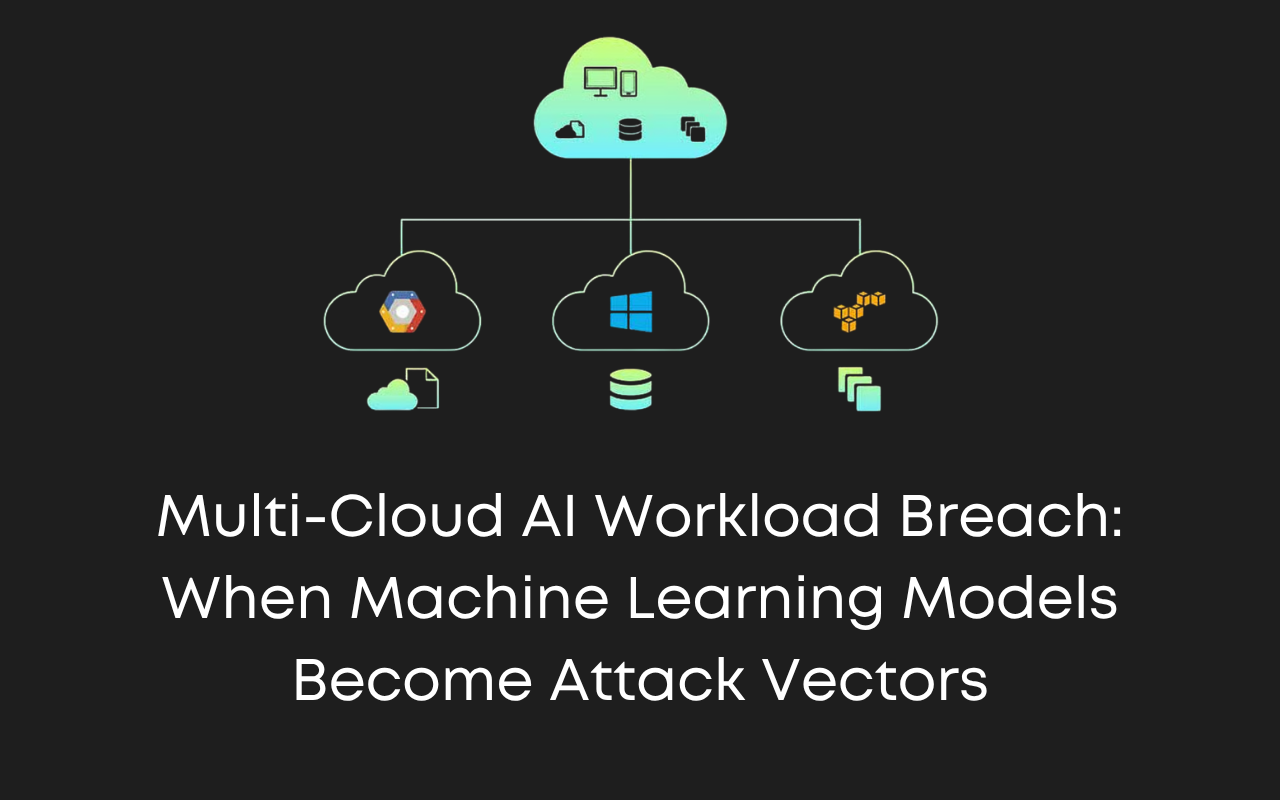
In recent years, organizations have increasingly deployed AI and machine learning (ML) workloads across multi-cloud architectures to maximize flexibility, scalability, and resilience. However, the spreading of model deployment across multiple cloud platforms also expands the attack surface—turning AI models themselves into potential vectors of attack.
This case study explores a hypothetical (but plausible) breach scenario in 2025, draws from academic research, and derives lessons and prevention strategies. The goal is to help organizations understand how models can be exploited and how to defend AI workloads in multi-cloud environments.
Breach Scenario: “Project Athena” — A Multi-Cloud AI Compromise
Background
-
A fintech company (let’s call it FinAI Corp.) develops an AI fraud detection model.
-
To ensure redundancy and geographic performance, the model is deployed across AWS, Azure, and Google Cloud.
-
The model uses training data drawn from multiple regions, with data pipelines, storage, inference APIs, and orchestration services distributed across clouds.
-
Access is managed via service accounts, IAM roles, cross-cloud networking, and federated identity systems.
Attack Vector & Sequence
-
Model Extraction & Reconnaissance
-
The attacker begins by calling the inference API on one cloud endpoint, capturing input-output pairs.
-
Using techniques of model extraction, the adversary trains a surrogate (approximate) model locally to mimic the target model’s responses.
-
They use this surrogate to reverse-engineer the decision boundary, gain insight into feature weights, and infer internal behavior. (This matches known model extraction risks in distributed environments) arXiv
-
-
Adversarial Input / Poisoning Attack
-
The attacker then crafts adversarial inputs—slightly perturbed examples that cause misclassification (e.g. false negatives in fraud detection).
-
They feed these malicious inputs to the other cloud endpoints (Azure, GCP) to test robustness.
-
-
Privilege Escalation via Identity Misconfiguration
-
The attacker identifies a misconfigured IAM role or service account in one cloud region with overly broad permissions (e.g. ability to list storage buckets or access logs).
-
With that, they gain read access to training datasets or data pipelines.
-
-
Cross-Cloud Lateral Movement
-
Using compromised credentials and network connectivity, the attacker moves from one cloud to another, bridging AWS → Azure → GCP, searching for orchestration layers, pipelines, or storage where model artifacts, weights, or data reside.
-
-
Model Poisoning & Backdoor Insertion
-
The attacker subtly alters model parameters or datasets used for retraining, embedding a backdoor trigger—inputs containing a hidden pattern (e.g. a specific bit mask or feature) trigger malicious behavior (e.g. bypass fraud detection).
-
Because the backdoor is small and stealthy, it remains undetected during routine validation.
-
-
Exploit & Exfiltration
-
At runtime, the attacker uses the backdoor trigger to evade detection on high-value transactions.
-
Simultaneously, they exfiltrate model weights, metadata, and training data to external storage.
-
They also insert logging or telemetry to monitor how often the backdoor is used, covering tracks.
-
Impact
-
The company’s fraud detection fails partially—some fraudulent transactions go unnoticed, leading to financial loss.
-
The attacker now knows internal model logic; competitors or fraud rings may replicate or exploit the model.
-
Regulatory, legal, and reputational fallout: customer trust is eroded, compliance investigations ensue.
-
The breach model has cross-cloud consistency, meaning defenses on individual clouds appear intact while the attacker moved laterally across them.
Lessons Learned
From this scenario and the academic literature, several key lessons emerge:
-
Models are not passive assets
AI/ML models can themselves be attacked—either by extraction, poisoning, inversion, backdoor insertion, or adversarial inputs. -
Multi-cloud increases complexity and risk
Each cloud introduces its own identity, network, and permission model. Bridging them introduces potential gaps. -
IAM and permissions must be tightly controlled
Overly broad roles, cross-cloud trust, or misconfigurations are prime enablers of lateral attacks. -
Adversarial & backdoor threats are real
Attackers may hide triggers in model logic that evade standard testing and only activate under rare conditions. -
Model versioning & validation are critical
Without strict validation and versioning, stealth changes can go undetected. -
Monitoring and anomaly detection must include model behavior
Deviations in model outputs, confidence scores, or input distributions should be monitored. -
Forensics in AI systems requires retaining artifacts and histories
Logs, model checkpoints, drift metrics, and pipeline metadata must be preserved to trace changes or intrusion. -
Defense is multi-layered
Relying on a single cloud’s protections is insufficient—defense-in-depth across clouds, networks, and AI layers is needed.
Prevention Strategies & Best Practices
Here are strategies that organizations like FinAI Corp. could adopt to mitigate risks:
A. Safe Model Deployment & Hardening
-
Use model watermarking and integrity checks to detect unauthorized model changes.
-
Employ differential privacy or homomorphic encryption for sensitive training data.
-
Limit exposure of inference APIs (e.g. rate limiting, input validation, anomaly detection).
B. Strict Identity & Access Controls
-
Follow least privilege — service accounts and roles should only have minimal permissions needed.
-
Use zero trust identity principles across clouds; avoid implicit trust between clouds.
-
Enforce multi-factor authentication (MFA) and rotate keys frequently.
-
Monitor non-human identities (NHIs / machine identities) and audit their activities.
C. Pipeline & Data Security
-
Encrypt data at rest and in transit across clouds.
-
Validate all data inputs and sanitize or filter suspicious inputs.
-
Use secure pipelines (CI/CD, retraining, model deployment) with version control, code signing, and checksums.
-
Isolate training / validation environments separately from inference paths.
D. Model & Behavior Monitoring
-
Maintain drift detection: monitor changes in input distributions or model output distributions.
-
Use anomaly detection engines to highlight unusual model behavior (e.g. sudden confidence shifts).
-
Log input patterns, output scores, feature importance, and maintain audit trails.
E. Cross-Cloud Visibility & Security
-
Use observability tools that provide unified logging, metrics, tracing across all clouds.
-
Use security orchestration and response platforms (SOAR) to correlate signals across clouds.
-
Employ CSPM / CWPP / CNAPP tools with AI awareness for multi-cloud.
F. Periodic Red Teaming & Adversarial Testing
-
Conduct penetration tests and red team exercises specifically targeting AI models.
-
Use adversarial training to strengthen model robustness.
-
Simulate model extraction and poisoning attacks to test defenses.
G. Backup, Recovery & Version Control
-
Maintain backup copies of models, datasets, and metadata in secure, immutable stores.
-
Use cryptographic versioning and audit trails to compare versions over time.
-
Ensure rollback capabilities if a compromised model is detected.
Potential Real-World Supporting Research & Incidents
While no confirmed large-scale multi-cloud AI workload breach is publicly documented yet, the research community is actively warning about emerging threats:
-
A recent paper on “Exploiting Artificial Intelligence for Cyber Attacks in Multi-Cloud Hosted Applications” describes how ML models can be weaponized to evade detection, mimic legitimate behavior, and exploit configuration inconsistencies across clouds.
-
A survey on model extraction attacks in distributed environments warns that deployed models (especially in cloud or federated settings) are vulnerable to reverse-engineering and theft.
-
The State of Cloud & AI Security 2025 article notes that misconfigured cloud infrastructures and AI workloads are emerging vectors for breaches, exacerbating risk in hybrid/multi-cloud setups.
-
The 2025 Hybrid Cloud Security Survey reveals that many security teams admit lacking visibility into AI workloads and treat large language models (LLMs) and AI services as “black boxes”—introducing blind spots.
-
IBM’s Cost of a Data Breach Report 2025 reports that 97% of organizations that experienced an AI-related security incident lacked proper AI access controls.
These studies strongly suggest that breaches like our hypothetical “Project Athena” are not far-fetched — they align with the direction of academic caution and early industry signals.
Conclusion
The rise of multi-cloud AI workloads brings tremendous benefits — scale, resiliency, and agility — but also harbors new threats. As organizations push ML models across hybrid architectures, adversaries will increasingly target models themselves as attack surfaces.
To stay ahead, defenders must treat AI models as active security assets — protecting not just the infrastructure around them, but the models, inputs, outputs, and pipelines. Enforcing rigorous identity controls, monitoring model behavior, securing pipelines, and testing against adversarial threats are all key.
October is the perfect time (Cybersecurity Awareness Month) to start raising this awareness: educate your teams, audit AI systems, and build multi-layered defenses for a future where machine learning models are not just tools—but potential attack vectors.
References
-
IBM Security. (2025). Cost of a Data Breach Report 2025. IBM Corporation.
https://www.ibm.com/security/data-breach -
Palo Alto Networks Unit 42. (2025). The State of Cloud Threats Report.
https://unit42.paloaltonetworks.com/cloud-threat-report/ -
Microsoft Security. (2025). Defending AI Workloads in Multi-Cloud Environments.
https://www.microsoft.com/security/blog -
Google Cloud Security. (2025). Machine Learning Supply Chain Risks and Mitigation Strategies.
https://cloud.google.com/security -
CrowdStrike Intelligence. (2025). Adversarial AI: Emerging Threats in Cloud-Native Applications.
https://www.crowdstrike.com/resources/ -
NIST. (2024). AI Risk Management Framework (AI RMF 1.0).
https://www.nist.gov/itl/ai-risk-management-framework -
Gartner. (2025). Top Trends in Cloud Security and Compliance.
https://www.gartner.com/en/research
#AIModelSecurity #CloudBreach #ModelPoisoning #AIAttacks #MultiCloudSecurity