

Want educational insights in your inbox? Sign up for our weekly newsletters to get only what matters to your organization. Subscribe
Framework for effective threat hunting programs with hypotheses, investigation techniques, tooling, and success metrics
Modern cyber threats no longer wait to be detected — they hide, persist, and evolve. Security teams that rely solely on alerts, SIEM rules, or endpoint notifications are already steps behind sophisticated attackers. This is why threat hunting has become a critical function for organizations aiming to proactively identify suspicious activity before it becomes a breach.
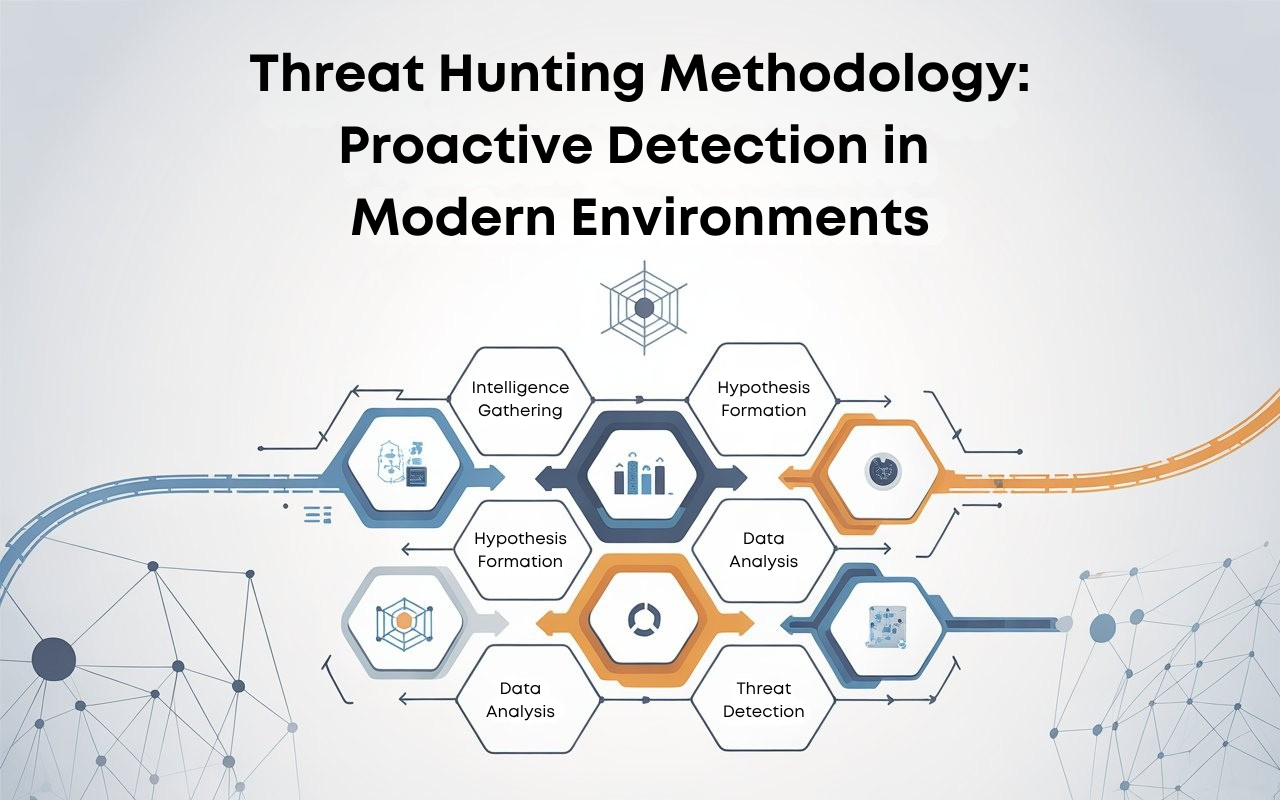
This educational guide breaks down the core methodology of threat hunting, including how to form hypotheses, investigate leads, use the right tools, and measure success.
What Is Threat Hunting?
Threat hunting is a proactive, intelligence-driven approach to discovering malicious activity that has slipped past traditional security controls.
Unlike reactive detection (waiting for alerts), threat hunting focuses on:
-
Finding hidden attackers
-
Uncovering unknown malware
-
Detecting lateral movement
-
Identifying behavioral anomalies
-
Validating or disproving hypotheses
Effective threat hunting is a structured, repeatable process — not guesswork.
1. Building a Strong Threat Hunting Framework
A well-defined program includes people, process, and technology working together.
The four key components are:
1.1 Threat Intelligence Foundation
Threat intelligence helps hunters understand:
-
Current threat actors
-
Known attack patterns (TTPs)
-
Indicators of compromise (IOCs)
-
Industry-specific risks
-
Emerging vulnerabilities
This knowledge sharpens hunting direction and reduces noise.
2. Forming a Threat Hunting Hypothesis
Every hunt begins with a hypothesis — a logical assumption based on observed behavior or intelligence.
Examples of strong hypotheses:
-
“A threat actor may be using valid credentials for lateral movement.”
-
“A newly exploited zero-day may exist in our environment.”
-
“A dormant malware beacon may be communicating periodically to a suspicious domain.”
Hypotheses guide data collection, investigative paths, and tool selection.
3. Data Collection and Visibility
Hunters need deep visibility across the environment. Key telemetry sources include:
3.1 Endpoint Data
Process creation, file modification, registry changes, command execution.
3.2 Network Data
DNS logs, PCAPs, unusual outbound connections, proxy logs.
3.3 Cloud & SaaS Logs
IAM activity, API calls, unusual authentication patterns.
3.4 Identity Logs
Kerberos events, privilege escalation, MFA anomalies.
3.5 Application and Infrastructure Logs
Containers, microservices, virtualization platforms.
Visibility = successful hunting.
Gaps in logs often equal gaps in detection.
4. Investigation Techniques
Threat hunters rely on a combination of behavioral, statistical, and intelligence-based analysis.
4.1 Behavioral Analysis
Focus on suspicious patterns such as:
-
Unusual PowerShell activity
-
Abnormal login locations
-
Unexpected privilege escalations
4.2 IOC-Based Hunting
Using known indicators sourced from:
-
Threat intelligence feeds
-
Security vendor reports
-
Previous incidents
4.3 TTP-Based Hunting
Mapping activity to MITRE ATT&CK techniques to identify attacker behavior even without IOCs.
4.4 Anomaly Detection
Looking for deviations from normal baselines, such as:
-
Network traffic spikes
-
New processes on sensitive systems
-
Rare service accounts used at odd times
5. Essential Tools for Threat Hunting
5.1 SIEM Platforms
Splunk, Elastic, Microsoft Sentinel — used for data correlation and querying.
5.2 EDR/XDR Tools
CrowdStrike, SentinelOne, Palo Alto Cortex — crucial for endpoint telemetry and behavioral detections.
5.3 Threat Intelligence Platforms
Recorded Future, MISP, Anomali, OpenCTI.
5.4 Scripting & Automation
Python, PowerShell, Jupyter notebooks for custom analysis.
5.5 Visualization Tools
Grafana, Kibana, Maltego for mapping attacker activity, domains, and infrastructure.
6. Documenting Findings and Producing Outputs
A professional threat hunt produces actionable output:
-
Confirmed or disproved hypothesis
-
Indicators discovered
-
Potential threat actor behavior
-
System weaknesses
-
Recommended detections to add
-
Hardening steps to implement
Documentation ensures repeatability and improves overall detection maturity.
7. Success Metrics for Threat Hunting Programs
Organizations often struggle to measure hunting effectiveness.
Key performance indicators include:
7.1 Detections Created
How many new SIEM or EDR rules were built from hunts?
7.2 Mitigated Vulnerabilities
Did hunters discover configuration weaknesses or identity gaps?
7.3 Time to Identify New Threats
How quickly were hidden behaviors revealed?
7.4 Reduction in Alert Fatigue
Better detection logic → fewer false positives.
7.5 Incidents Prevented
A strong indicator of ROI for the entire threat hunting program.
8. Why Proactive Threat Hunting Matters Today
Modern environments are:
-
Cloud-driven
-
API-powered
-
Identity-centric
-
Borderless
-
Highly targeted
Attackers take advantage of complexity.
Threat hunting ensures your team finds them before they cause damage.
Benefits include:
✔ Faster detection of stealthy adversaries
✔ Better understanding of internal weaknesses
✔ Stronger detection engineering
✔ Improved security posture
✔ Lower breach impact
Threat hunting is no longer optional — it is a competitive necessity.
Final Thoughts
A structured threat hunting methodology helps security teams shift from reactive defense to proactive discovery. By building hypotheses, leveraging intelligence, using the right data sources, and measuring outcomes, organizations can significantly reduce their risk exposure and operate with confidence in today’s threat landscape.
#ThreatHunting #ProactiveSecurity #ThreatDetection #SecurityHunting #CyberDefense